
Planning a trip to Phuket in 2026–2027 and wondering how to get around the island? Renting a car is the most popular and affordable way to explore the island with your family or friends without overpaying for a taxi. For example, a taxi from the airport to Karon or from Patong to Naiharn will cost the same as hire a car for a whole day. In this detailed guide, we'll answer the most important question: how much does it cost to rent a car in Phuket? You'll learn current prices for different car classes, from economical city cars to electric vehicles, seasonal price differences, deposit amounts, and important details to consider before signing a contract.
Price to hire a car in Phuket
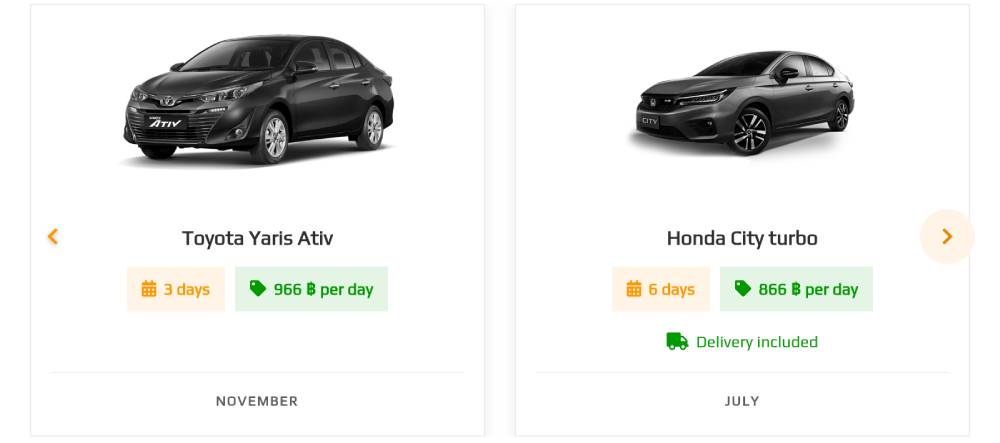
Car hiring prices in the 2026-2027 season range from 500 baht per day for a compact car to 1,500 baht for more comfortable and spacious vehicles. For a 7-10-day rental, you should expect to spend 800-1,200 baht per day for a comfortable, modern car.
What does the rental price depend on?
The rental price depends directly on the car class, year of manufacture, tourist season, and rental term. The same vehicle will cost differently in a different season and for different rental periods. The longer hiring, the lower the daily rate. Discounts start at just three days, and the most significant savings are achieved with a monthly contract.
Below are the current prices for 2026-2027:
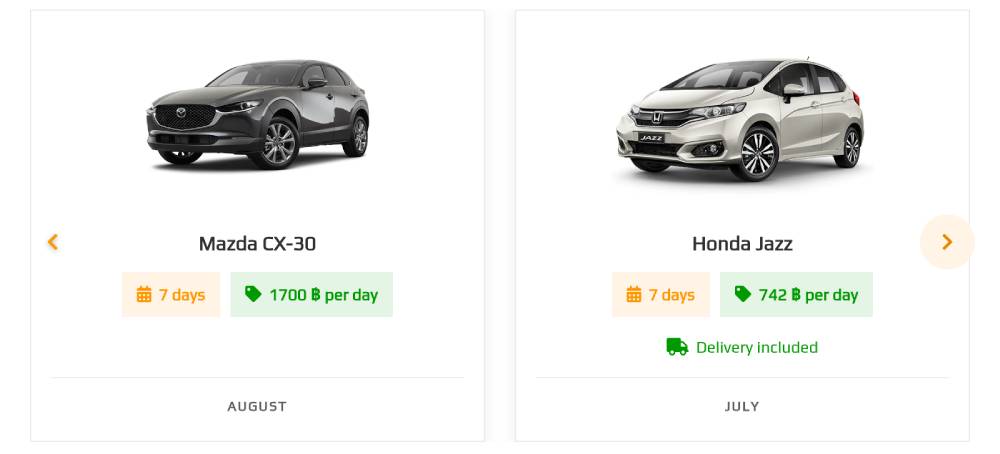
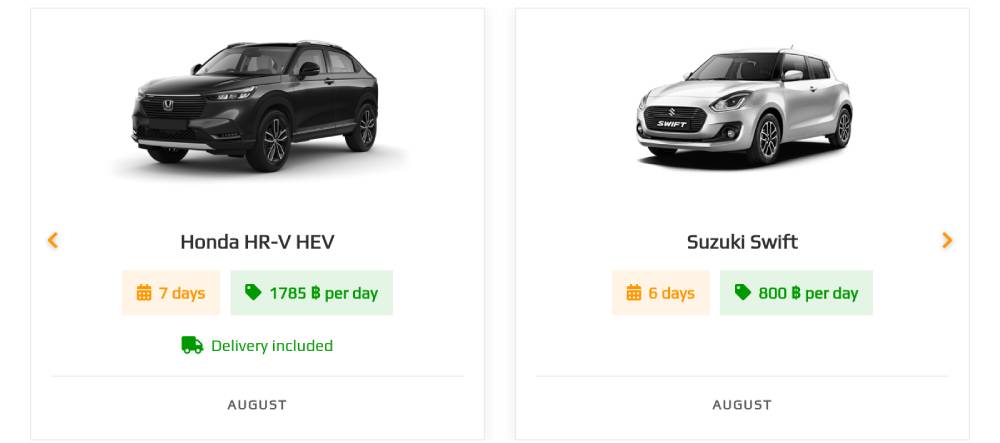
Economy options such as Toyota Yaris, Suzuki Swift, Nissan Almera, Honda Jazz, Toyota Ativ, Honda City will cost you 600-1000 baht for daily rental and 12,000-20,000 baht for rentals of 3 weeks or more.
Middle class MG 5, Toyota Altis, Honda Civic 1500-2000 baht for daily rent and 20,000-25,000 baht for long-term rental.
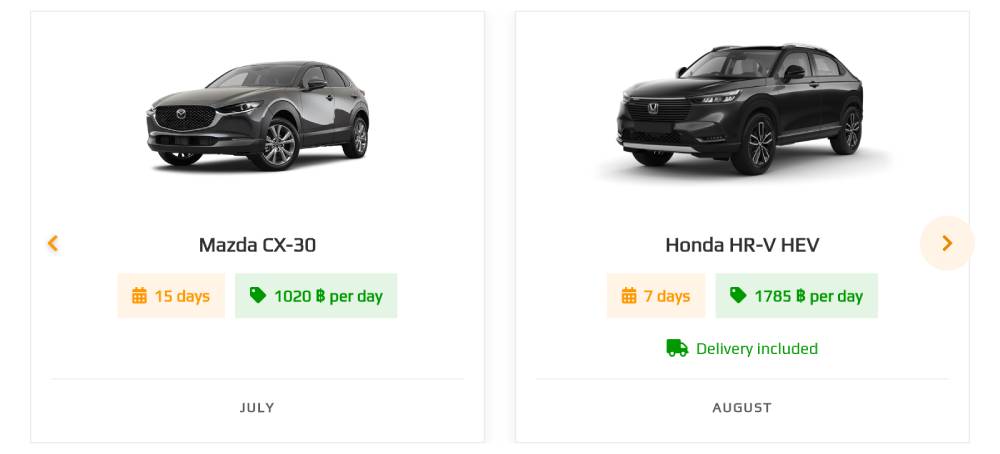
Crossovers MG ZS, Toyota Yaris Cross, Honda HR-V, Mazda CX-30 1000-1800 baht/day, 25,000-35,000 baht/month.
SUVs and family minivans MPVs Toyota Fortuner, Mitsubishi Pajero Sport, Toyota Veloz, Mitsubishi Xpander 1400-2500 baht per day, 40,000-65,000 baht per month.
Electric cars BYD Atto 3, BYD Dolphin, Changan Deepal S07 1100-2200 baht per day, 30,000-45,000 per month.
How does the season affect rental prices?
Phuket is a highly seasonal resort, and car rental prices vary depending on the time of year:
- Low season (May-October): The most profitable time. Demand is low and there are few tourists, so prices drop significantly: compact cars can be found for 500-700 baht per day and 10,000-13,000 baht per month.
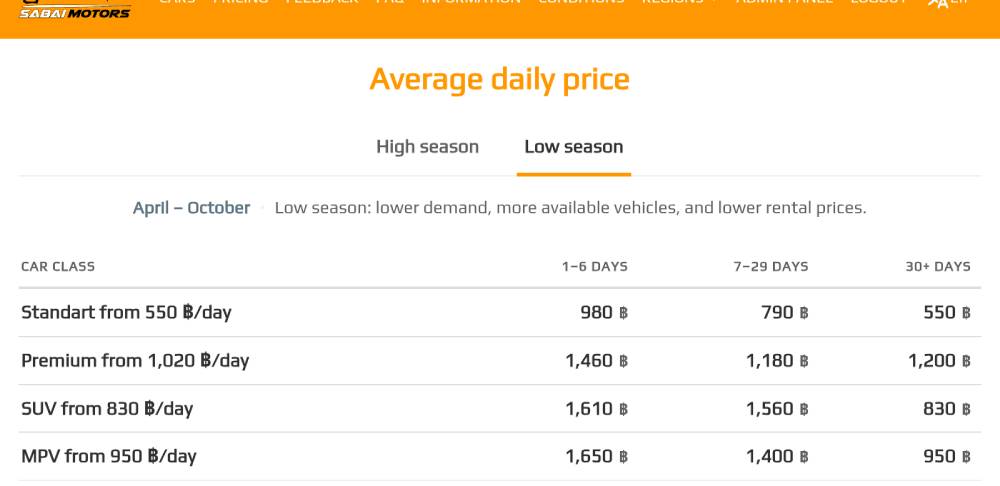
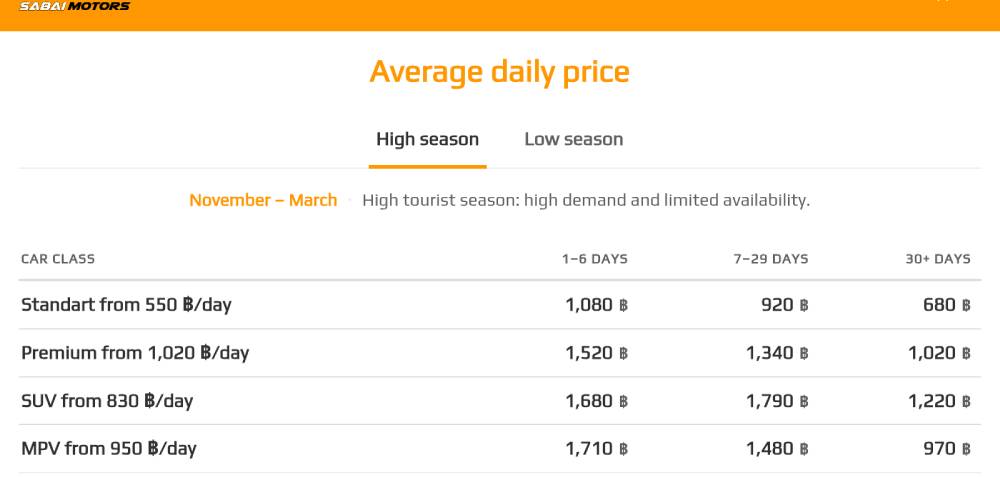
- High season (November-April): Steady demand, dry, sunny weather. Prices for basic models rise to 800-1,200 baht per day and 15,000-23,000 baht per month. It's best to book a car 3-4 weeks before arrival.
- Peak Season (December 20 - January 15): During the New Year and Christmas holidays, prices increase by 30-50%, and available cars are sold out two months in advance.
What else does the final amount depend on?
Rental period. The longer the period, the lower the daily rate. A monthly rental is 30-40% cheaper per day compared to a 3-days trip.
Insurance. Basic insurance (similar to compulsory motor insurance/CDW with a deductible) is usually included in the price. Full coverage (no deductible), which protects against minor scratches in parking, adds approximately 150-300 baht per day to the cost, but only a limited number of rental companies offer it.
Security deposit. The rental company requires a refundable security deposit for the rental period. Local companies typically charge 3,000-5,000 baht for budget cars and 7,000-15,000 baht for other cars. Payment can be made in cash in the local currency, the equivalent in dollars or euros, or in some places even cryptocurrency is accepted. International chain services charge between $300 and $500, and credit cards are the only accepted method.
Pickup and drop-off. Car delivery to Phuket Airport is almost always free. Most companies have offices near the airport. However, delivery to other areas may incur an additional fee. The surcharge depends on the distance to the delivery location and the rental period. Typically, it's 200-600 baht one-way.
Additional equipment, such as a child seat, a phone holder, or GPS, may be available. This varies by rental company. Some rentals offer them for free, while others require an additional fee.
Additional costs to be aware of
*Fuel. In Phuket, gasoline (Gasohol 91/95) costs 38-42 baht per liter. A compact car will cost around 1,000-1,500 baht for a week's driving around the island. Cars are typically rented with a full tank and must be returned with a full one.
*Paid parking. Parking is free on most beaches and at shopping centers, but paid parking at some attractions or in the Old Town costs 20-50 THB.
* Fines. The most common fines are not having an IDP, illegal parking, and speeding. The fine for not having a license is 1,000-2,000 THB. Parking and speeding are each 500 THB. The first and second fines are paid immediately, and the third is mailed to the vehicle owner a month later, when you'll likely be back home in your home country. The rental company may contact you and request payment. Whether you do so is your choice. There will be no consequences other than a damaged relationship with the company.
What documents are needed to rent a car in Phuket?
- International passport (valid for the duration of the trip)
- Driver's license. National driver's license + International Driver's License (IDP) category B or local Thai driver's license if available
- Deposit. Cash or card, depending on the terms of the selected rental company.
- Age from 21 years and driving experience from 1 year
3 simple tips on how to save money
Book in advance, especially during New Year's and local holidays. Thais also enjoy traveling around the country and renting cars. The closer your arrival date gets, the fewer options become available.
Rent a car for the entire duration of your vacation. A 10-14-day rental will cost less per day than two separate 3-day rentals.
Record the car's condition. Be sure to take detailed videos and photos of the exterior and interior with the employee when signing the contract to avoid disputes upon return day.
Local rentals vs. international chain companies (aggregators): which to choose?
When booking a car in Phuket, you have two main options. The choice depends on your credit card availability and preferences. International companies (Hertz, Sixt, Budget, Avis) often offer better prices due to higher demand and a larger fleet. Private local businesses can't compete, but offer a more welcoming and friendly environment: live chat, the opportunity to negotiate a discount, and the ability to ask for advice on where to go and what to see. You're not only renting a car, but also making new local connections.
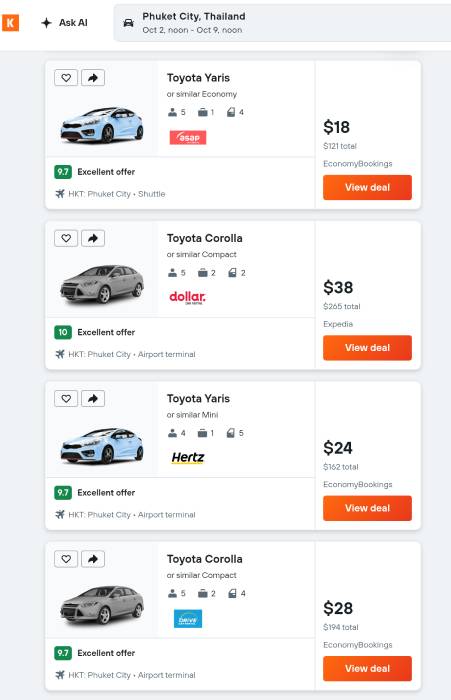
The main disadvantage of chain companies is the mandatory credit card requirement. Hire and deposit payments cannot be made in cash or by debit card. Small businesses, on the contrary, prefer cash . Best of all, the cash deposit is returned immediately upon car return, while the card balance must be unfrozen for a month.
Furthermore, international rental companies don't offer delivery and pickup services. You must pick up the car at their office but they are always located at the airport area, though rarely in other areas. This is convenient if you're ready to get the car immediately upon arrival, but if you're already at your hotel, you'll have to pay for a taxi to and from the office. In such situations, private rental companies are a clear winner. Delivery service may be subject to a fee, but the cost is not comparable to a taxi.
Driving in Phuket: What to expect
Driving in Thailand has its own nuances, which are easy to get used to in the first couple of days or even hours:
* Left-hand traffic. The main rule is that left turns at intersections are often permitted on a red light (unless there's a prohibiting sign or a separate arrow), but you must ensure you're not obstructing anyone or creating an emergency. First, yield to anyone driving on the right and only then proceed.
* There are a huge number of scooters. Bikers overtake from all directions, change lanes suddenly, and are often in blind spots. Check your side mirrors frequently before maneuvering.
* Mountains. The roads between beaches (for example, Patong-Karon-Kata) run along mountain serpentines with steep climbs and descents. Use L or S/2 (engine braking) mode to avoid overheating the brake pads on the descent and to make it easier to enter the climb. In Thailand, almost all compact cars are made with a 1.2-liter engine, which often confuses non-local drivers. They feel like the car won't budge, especially if it's fully loaded. This is where a low-range transmission comes in handy.
* Driving on roundabouts. The right-of-way is given to the driver already on the roundabout (yield to the right-hand side). However, keep in mind that Thais often don't follow the rules, so don't force your way through, but rather drive according to the situation.
* Curb markings:
Red and white: Parking and stopping are strictly prohibited.
Yellow-white: Public transport stopping or unloading area (passenger drop-off or parking for no longer than 5 minutes is permitted, long-term parking is prohibited).
Black and white: Parking allowed.
Pay attention to parking signs. If the curb is colorless, there's likely a specific sign there, permitting or prohibiting parking.
Electric vehicle (EV) rental in Phuket in 2026-2027
Over the past two to three years, the island's electric vehicle infrastructure has made significant progress. BYD, MG, and Changan models have become rental hits.
* Pros: Fast acceleration, perfect silence in the cabin, modern technologies (large screens, autopilot/assistants) and savings on trips of up to 50-60% compared to gasoline.
* Charging stations: Charging stations are available at most large petrol stations (PTT, Shell), shopping centres (Central Festival, Jungceylon, Robinson) and hotels.
*What you need to know: To charge, you will need to upload Thai applications (for example, PEA VOLTA or EleXA) and link an international card.
How and what to refuel a car with
* All gasoline cars in Thailand use Gasohol 95, Gasohol 91, and E20. The fuel type is always indicated on the inside of the fuel filler flap, but 95 is most commonly used-it's more powerful and consuming more slowly. Be sure to confirm which fuel to use with the rental company, especially if you're renting a diesel vehicle (which includes almost all SUVs and minivans). If the engine breaks down, you'll be responsible for the repairs.
* How to fill up: No need to get out of your car. Just pull up to the pump, open the window, tell the staff the fuel type and amount (e.g., 95, full tank, or 91, 500 baht), and pay in cash or by card right through the window.
* The best gas station chains are: PTT (the largest chain with 7-Eleven stores, an Amazon coffee shop, and food trucks), Shell, Caltex, and Bangchak. All stations, even the smallest ones, have free restrooms. Fuel prices are the same everywhere, except for Shell, where they're a few satangs (cents) higher.
What to do if you're in an accident or your car is scratched
Don't panic and don't leave the scene of the accident.
Do not move the vehicle until an insurance company representative or the police arrive.
Contact the rental company immediately. Inform the manager of the situation; they will call the insurance agent and advise you on the next steps.
Take photos and videos: Record the positions of all parties involved in the accident, the license plates of the third party, any damages of your car, road signs, and a general view of the road. All of these will be needed if the police ask you to move your car to avoid creating a traffic jam.
If another participant in an accident is aggressive, wants to leave the scene of the accident, or does not speak English, call the tourist police 1155.