Hire a car in Thailand is an absolute freedom, but it's also the trap where inexperienced tourists most often lose money. And this "scam" doesn't necessarily involve outright fraud: sometimes rental companies simply exploit your inattention and legal ignorance.
The rules of the game for cars and bikes are very different. Let's break down how to protect your wallet.
Deposit and payment
The main golden rule: No passport as a deposit
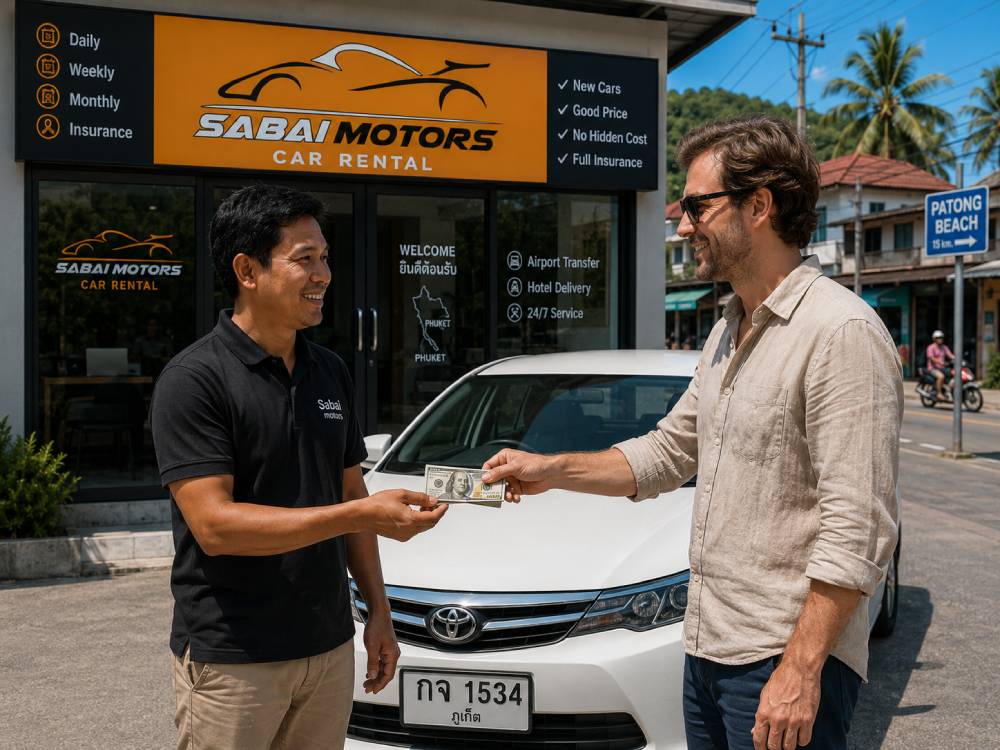
The main requirement for renting a vehicle in Thailand is a deposit. It serves as additional insurance against uninsured events when renting a car and covers damage when renting a scooter (as two-wheelers are not insured). Rental companies offer two types of deposits: a passport or cash. However, the former is completely illegal, and if you find a place that requires you to leave your original passport, turn around and walk away. This is more common when renting a scooter.
Remember: Your passport is the property of your government. By leaving it with someone in a beach tent, you're voluntarily putting yourself hostage. When you return the vehicle, they might accuse you of a scratch that wasn't there (or maybe it was, but they're just trying to make more money off you) and demand compensation for damages. Without your passport, you'll lose control of the situation and won't be able to prove anything, fly home, or go to the police. You'll have to pay either way to get your document back.
The correct way: Large and reliable companies only accept a cash deposit as collateral.
The deposit varies among car rental companies and depends on the class: for budget options, it's usually 5,000 baht, but you can find less; for higher-class cars, it's 6,000-10,000 baht; for large SUVs and luxury cars, it's 10,000-30,000 baht.
For motorcycles, the deposit is significantly lower: in Phuket and Samui, amounts vary between 1,000 and 5,000 baht for small scooters with a 100-125cc engine and 8,000-10,000 for more powerful bikes of 150-250cc.
International car rental chains freeze this amount on your credit card. Cash or debit cards are almost never accepted. Motorcycle rentals are more flexible and may accept cash. After the car is successfully returned at the end of the rental, the block is lifted, but it takes several days to a month for the refund to be processed. If the refund hasn't arrived within this timeframe, contact your bank or the rental company's customer service.
Small businesses prefer cash. You can leave a deposit in the local currency, the equivalent in USD or euro. You'll receive it back in the same currency immediately upon returning the vehicle.
Delivery procedure: We record everything on video
Vehicle pickup and return must be carried out with the utmost care, as negligence can lead to loss of funds. Only ironclad proof that the damage occurred before you will ensure a secure deposit refund. Don't trust the rental agent's statements: "Oh, I know about that scratch, it's okay, don't worry." Anything not captured on photo or video is the renter's fault.
Before signing the contract, thoroughly inspect the vehicle with a company representative: hood, roof, doors, bumpers, wheels, and mirrors. Look for any dents, scratches, or cracks. Similarly, inspect the interior: seats, instruments, bumpers, mirrors, headlights/brake lights, odometer, and fuel level. Start filming a high-quality video in one continuous take. Slowly walk around the vehicle. It's best to photograph minor scratches, as they may not be visible on video.
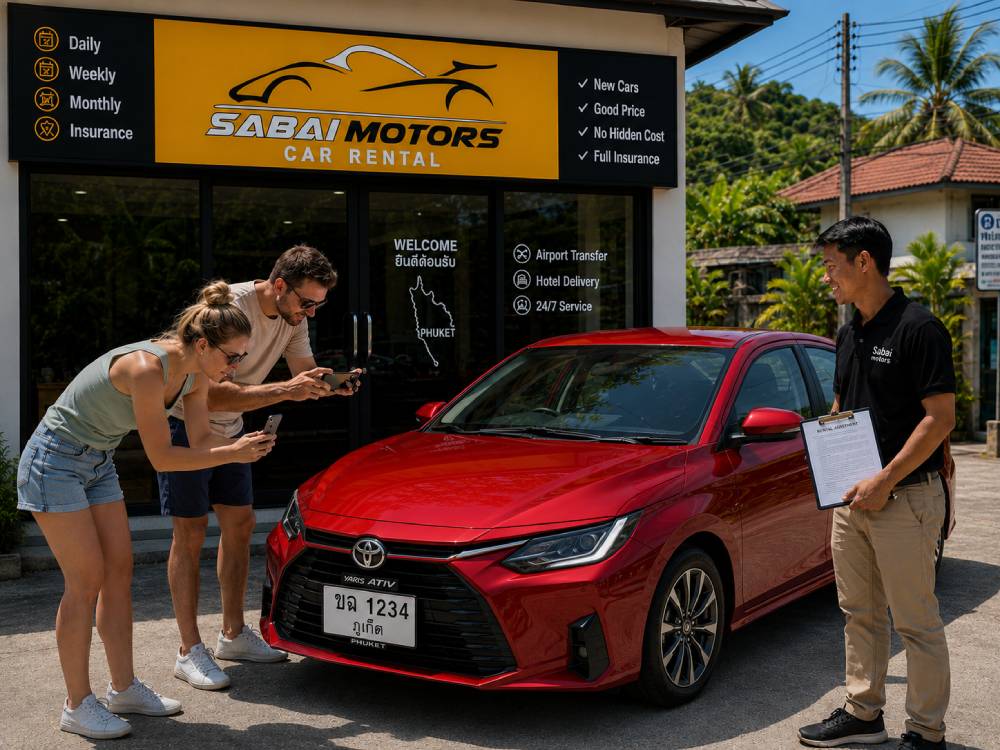
Pay special attention to hidden areas-underbody parts and plastics. Crouch down and look underneath the car or under the lower plastic of a bike. This is where old stone chips are most often hidden, which are then sold for money. Close-ups of mirrors, brake levers, and handlebar ends (grips) are removed.
Take a photo of the dashboard.
Check the vehicle's operating condition. Start the engine. Check the fuel level in the tank (replace the fuel exactly the same) and the current mileage. Make sure there are no errors on the dashboard, especially the Check Engine light. You can ask the driver to take the vehicle for a drive for a few kilometers to be completely sure all systems are working properly.
Include damage information in the contract. Ideally, the manager will note all the defects found on a special diagram in the paper contract, but if there are numerous minor damages, it can be difficult to note them all on a diagram, and in this case, your video will be your best insurance.
Myths and Realities about Insurance
Most tourists are sure that having insurance means they're completely protected from any accident costs. When renting a transport in Thailand, that's not how it works.
Comparing car and bike insurance
There are several types of insurance.
Mandatory (similar to compulsory motor third-party liability insurance). Available for all vehicles. Minimum damage coverage. Basic mandatory insurance provides only minimal limits of medical coverage for third parties. It completely excludes coverage for material damage to vehicles or third-party property, and does not cover leased vehicles.
Voluntary insurance First Class. Maximum coverage. It's available only for cars. If an accident is your fault, you pay only a fixed excess of 5,000-10,000 baht. This amount should be specified in the rental agreement. If you're not at fault, you pay nothing. All reputable rental companies offer an extended policy, as it primarily protects their property. This insurance shows the rental company's reliability. Large companies offer an additional option for purchasing maximum coverage without the excess. This means you have no risk at all, but the rental price increases significantly.
There are two types of Class 1 insurance: commercial and private. The former insures rental cars, the latter covers personal vehicles. There's a myth that you can't hire cars with private insurance, saying it won't work in the event of an accident. And like many myths about Thailand, this one is being thrown into the trash. Both types of insurance are perfectly valid, with one difference: the owner of the vehicle must be present at the scene of the accident.
Motorbikes don't come with this type of insurance. You pay for any scratches out of your own pocket, both to the other party involved in the accident and to the rental company. The contract must specify the amount you're liable for. This clause is essential, as it prevents the owner from trying to rip you off. For example, if the contract clearly states that your maximum liability is 30,000 baht, they won't be able to charge you more.
Theft. Covered by Class 1 insurance. If your bike is stolen, you'll pay the rental company its full market value (unless theft protection is included in the contract). Incidentally, vehicle theft isn't common in Thailand. More often than not, unscrupulous tourists don't return the vehicle themselves.
Lifehack for scooters: Since there's no commercial insurance for bikes, your primary protection is your personal travel medical insurance. Before your trip, make sure your policy includes the "Motorcycle/Moped Driving" or "Active Leisure" options. Regular travel insurance won't cover injuries from a motorcycle fall. And of course, it won't work unless you have a Category A driver license.
The Driver License Trap
This is the main legal nuance that 90% of tourists miss. According to Thai law, driving a vehicle requires a driver's license of the appropriate category- B for cars, A for motorbikes. Private motorcycle rental companies, especially in Phuket and Koh Samui, rent bikes without checking their license at all- they don't care, because you'll be the one paying if there's a problem. Private car rental companies accept national driver licenses with an English translation. International chains require an IDP.
But if you don't have a driver license with the correct category, any insurance is automatically voided. Insurance companies officially refuse to pay out if the driver isn't legally allowed to drive in that country. That's why motorcycle rental companies don't even contact insurance companies in the event of an accident, since the scooter only has compulsory motor third-party liability insurance. This doesn't make sense, since 99% of drivers don't have a license. An IDP isn't required for the insurance company; your national license will be fine, as long as it's the correct category. And a local Thai driver's license is absolutely not required. In any accident, the police are highly likely to find you at fault (or co-at fault) simply because you don't have a driver's license.
And most importantly, you can rent a car with your national license, but the police strictly require an IDP, whether you're driving a scooter or a car. Without one, you'll pay a fine of 1,000-2,000 baht. Cars are rarely checked, but motorbike drivers are a hot commodity.
Lease Agreement Tricks
Travelers are often so eager to start their vacation that they don't read the contract carefully or at all. Yet this is the most important document that protects you from being ripped off.
What to pay attention to first:
- It must be translated into English. If there is no translation, ask the rental employee to translate each clause, or do it yourself using Google Translate. You must read, understand, and agree to all clauses. Don't be shy about asking questions. It's your money. If you're not satisfied with even one clause, cancel the rental. Don't think it's unimportant. Everything is important, and the very thing that bothers you will work against you.
- Read especially carefully about the deposit, its refund conditions, and the amount you'll need to pay in the event of an accident or other damage. The deposit isn't always the deductible amount.
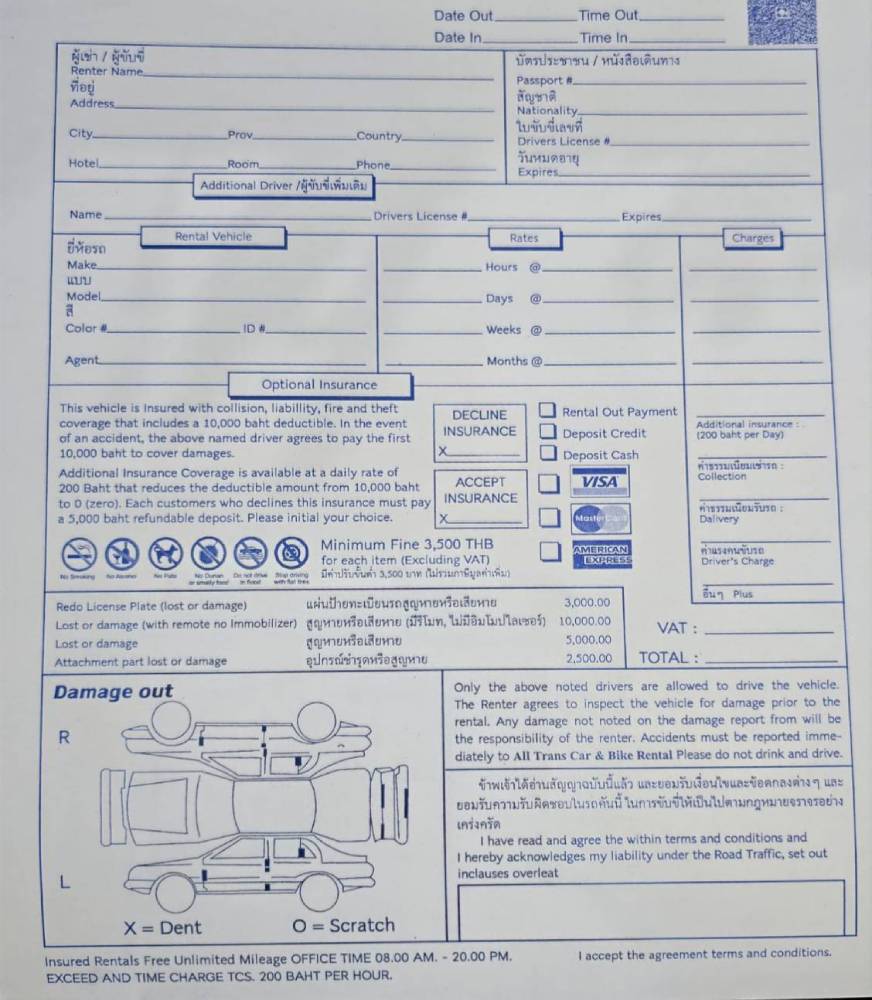
Keep in mind that insurance only covers accidents. If you scratch the car yourself, have a flat tire, a coconut falls on the roof, the battery dies, or anything else that didn't happen during an accident, you're responsible for everything, and that's what the deposit is for. The cost of the damage is deducted from it. Incidentally, here the terms of car and motorbike rentals are comparable. This is where most car renters fall into a trap and are very surprised when they're asked to pay for a scratch. After all, they were confident that the insurance would cover everything.
- rental terms. The contract always specifies the date and time of vehicle pickup and return. It also specifies penalties if you're late without notice. If you need to extend the rental period, be sure to coordinate this with the rental company in advance. Even if you're delayed by half an hour, the rental company should be informed.
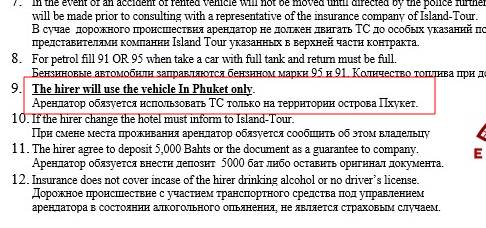
- travel conditions outside the rental area. Be sure to check this clause and confirm with the owner whether you can travel outside the city or province where you hired the vehicle, and under what conditions. This applies to both cars and motorbikes. This should be specified in the contract.
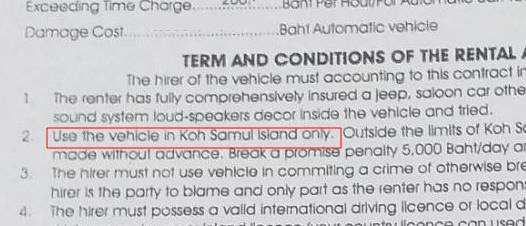
International chain companies typically allow travel throughout the country. Private businesses often object or only approve short trips. If you violate this rule and decide to travel without permission, you'll be fined at the end of your rental and likely lose your deposit.
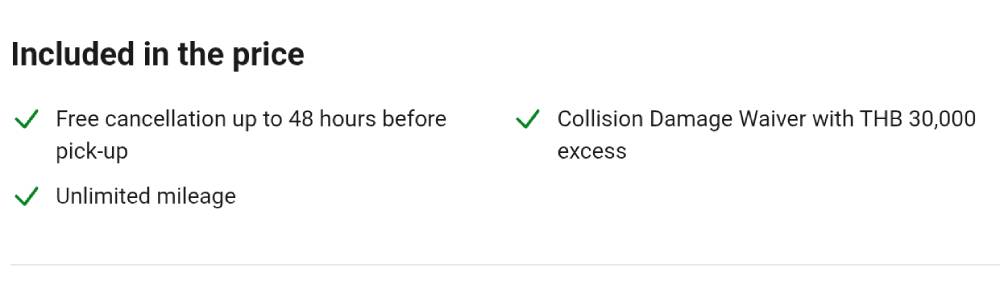
- mileage restrictions. There are usually no mileage restrictions when renting a vehicle in Thailand but they might appear if you drive to other cities and provinces. It's should also be specified in the contract.
A short checklist before handing over money:
- The vehicle is fully functional, you personally checked it, and have photos and videos of all damage.
- You have read the contract and understood every point.
- The contract clearly states the amount of the deposit, the terms of its return, and the amount of your financial liability for non-insurance claims and accidents.
- The fuel policy is stated. Typically, it's "Full-to-Full": pick up with a full tank, return with a full one. However, if you're not given a full tank and add more gas, there will be no reimbursement for the excess.
- You have all the rental company's contacts and you know what to do in emergency situations.
Read reviews and choose reliable companies whose rental terms completely satisfy you. Don't rush your choice. Fortunately, there's a large selection, especially for bikes (10 shops per square meter). Don't be fooled by cheap prices. A cheapskate pays twice. Trying to save 200 baht at a dubious street company can result in a loss of much larger sums. Don't focus only on price. Compare all the terms: insurance, deposit amount, vehicle condition, payment methods, and the staff's communication style. For some, English-speaking support may be an important consideration, while for others, payment by credit card may be a must.