
Traveling to Thailand with the whole family is a wonderful opportunity to see picturesque beaches, temples, and national parks at a comfortable pace. Public transportation with small children isn't always convenient, and it's only well-developed in the capital. In popular touristic cities, taxis, car rentals in Thailand, and scooters are the only options. Of course, most families prefer to hire a car. However, traveling with a child requires familiarity with local regulations and a careful approach to safety.
Do i need a child seat in the car?
Yes, it is not only necessary, but mandatory.
Amendments to the Land Traffic Act officially came into force in Thailand in August 2023:
* Children under 6 years of age (or up to 135 cm tall) must be transported in special car seats or booster seats.
* Children under 7 years of age are not allowed to sit in the front seat.
* Violation of the rules will result in a fine of 2,000 baht.
While car seat checks are less common on the road than International Driving Permit checks, the most important thing is your child's safety on Thailand's unpredictable roads.
How and where can I rent a car with a child seat?
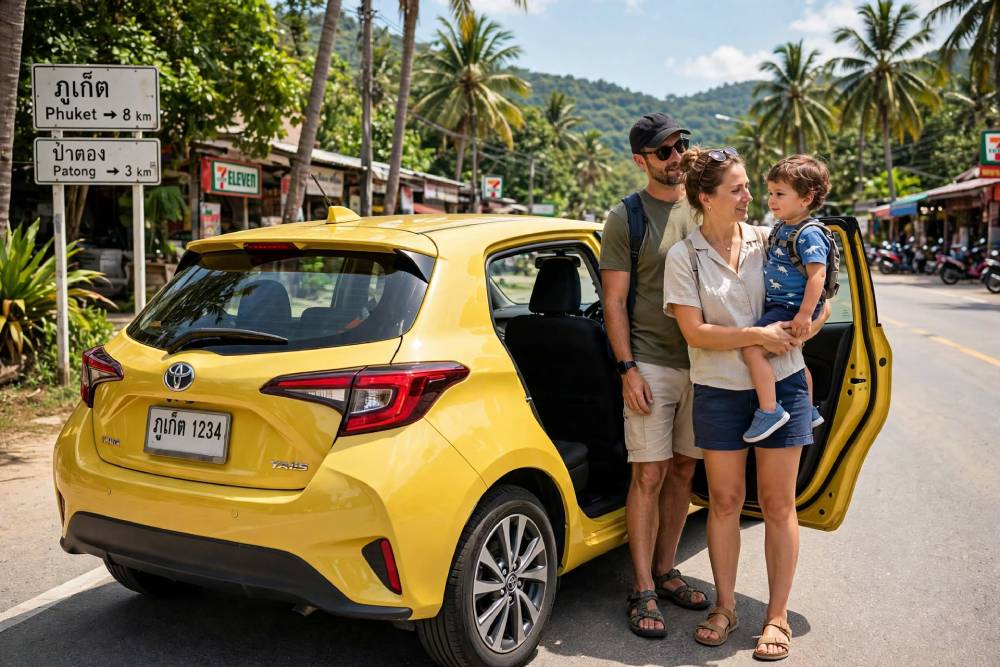
Most rental companies in Phuket, Koh Samui, Pattaya, and other popular resorts offer child seats as an optional extra. Some offer this for a fee, while others offer it free of charge.
Important tips:
Book in advance. Car seat availability is limited, especially during peak season (December-January). When booking, be sure to specify your child's age, height, and weight so you can get the correct category- a bassinet, car seat, or booster. Most companies only offer options for children aged 1 year to 4-5 years. Booster seats and bassinets are rarely available.
Cost. If the service is paid, it's usually charged per day for short-term rentals and a fixed price for long-term rentals, or free. On average, the cost is 100-200 baht per day.
Check the quality. Be sure to inspect the seat: the straps should work properly, the plastic should be free of cracks, and the mounting points (preferably the ISOFIX system) should be secure. Cleanliness is also a consideration. Reputable rental companies typically dry-clean the seat after each use.
If you can't find a suitable option, you can bring the chair with you and have it installed in your car, or buy an inexpensive model in Thailand and then leave it with the rental company or sell it.
Peculiarities of traveling with children
Driving conditions vary significantly across the country.
Car rental in Phuket. Phuket is a large island with very heavy traffic (the average speed on major highways is 100 km/h), challenging mountain roads, and a huge number of mopeds on the roads, which are driven very chaotically and do not adhere to traffic regulations. Driving here requires utmost concentration, so a securely fastened child car seat will protect your child during sudden maneuvers and braking.
The best car to choose depends on the number of passengers and the purpose of the trip. In Thailand, cars with 1.0-1.2 liter engines are common, which is a perfectly acceptable option for two adults and one child. If you have more than two adults and plan to travel through mountainous terrain and climb to viewpoints, a crossover or a car with a 1.5 liter engine or higher is better, but they will be more expensive. However, even a car with a 1.2 liter engine in low gear will easily handle the hills you'll encounter.
Car rental on Koh Samui. Traffic on Koh Samui is a bit calmer, as the island itself is smaller. Average speed is 60-80 km/h. However, there are more scooters and many narrow sections, making parking very challenging, and finding a free space can be a real quest. A compact hatchback or crossover is ideal for a family.
Helpful tips for parents
Keep an eye on the climate control. Make sure your car's air conditioning is working properly, as the heat and humidity in Thailand can be difficult for children to handle.
Allow for traffic. Roads at popular resorts can be congested, so plan your trips so your child doesn't get tired on the road.
Bring water and snacks. It's helpful to have a supply of drinking water and snacks in the cabin, as there may not be any shops nearby.
How locals transport their children
Although Thailand has a law regarding child car seats, the way Thais transport their children is puzzling.
1. Pickup truck body
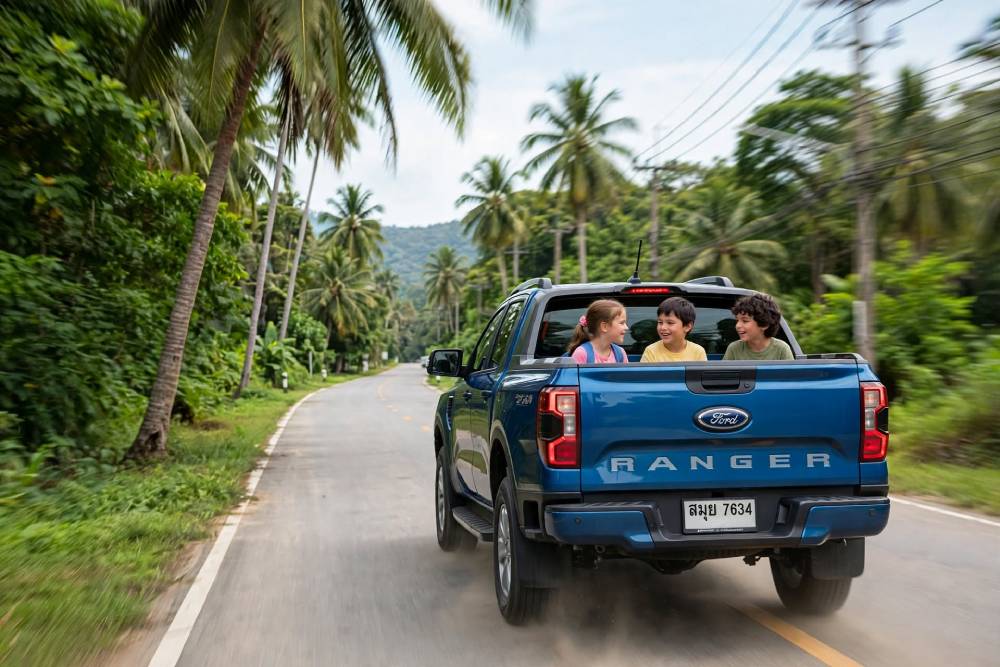
Pickup trucks are the most popular family vehicle in Thailand. Government discounts are available, and most families buy these vehicles as minivans, using the bed as an extra passenger compartment, comfortably accommodating up to eight people. Children sit directly on the sides, on the floor, or on plastic stools. Naturally, there are no seat belts or car seats, and speeds can reach up to 100 km/h.
Officially, Thailand regularly tries to limit the number of passengers transported in trucks (for example, by introducing a limit of up to six people or banning passengers on highways), but in practice, this is neither regulated nor prevented, especially in rural areas and during holidays.
2. Scooters and one-handed steering
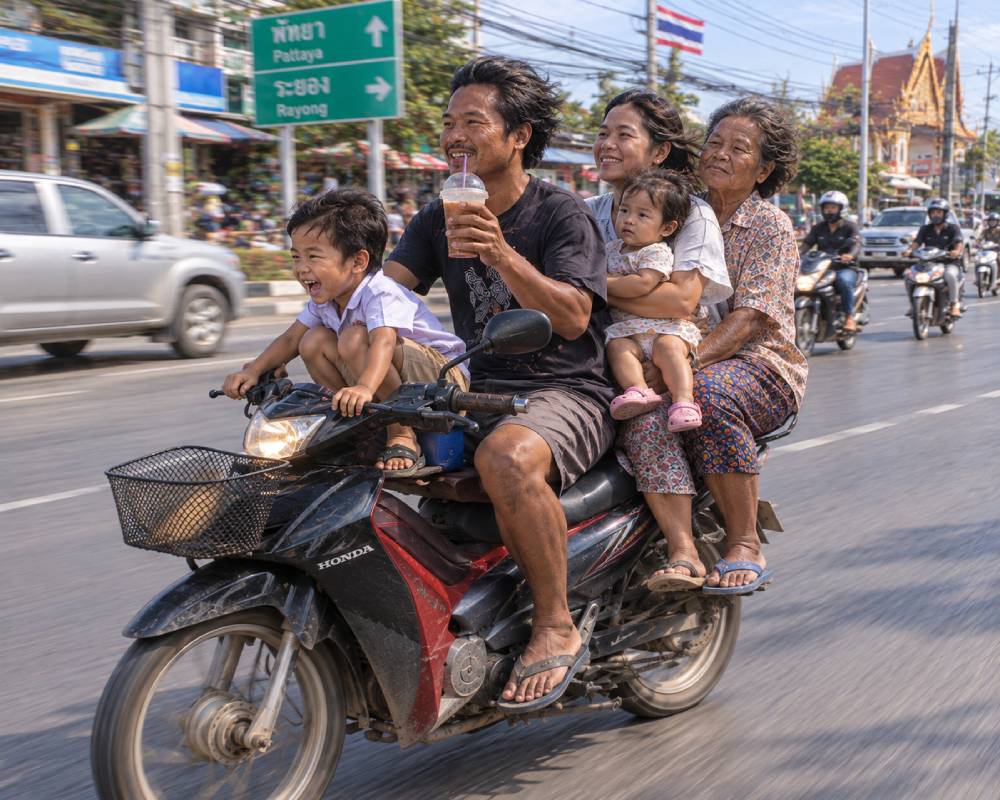
A motorbike is the most accessible means of transport for a Thai family. Often, the entire family rides on one moped: a mother holds a baby with one arm on the back seat while the rider steers, and the second child squats in front. Children under 3 years old often stand in front, between the handlebars and the driver, holding onto the center console or dashboard.
One-handed operation:
Riders often hold the steering wheel with one hand while using the other to support a child sitting in front or on their lap.
The law requires everyone, including passengers and children, to wear helmets, but in reality, Thais carry their protective gear in the trunk and only take it out at a police post to avoid a fine.
Important for tourists
Travelers come on vacation, observe local traffic, see locals transporting their children, and think it's normal. They start doing the same. But driving a scooter with a child without experience or transporting children in the back of a pickup truck is extremely dangerous for a foreigner due to a lack of familiarity with the specific local traffic and insurance restrictions. If your budget doesn't allow for renting a car, or you're afraid of driving in a foreign country (which is perfectly normal), or hiring a car isn't an option for other reasons, don't risk your health or of your child. Take a taxi or choose resorts with public transportation. In recent years, Phuket has focused on developing bus routes. Now, several buses run between the main areas of the island. You can take one from the airport to a particular area, for example, Bang Tao, and back. The downside is that they only travel on main roads, and if your hotel or final destination is located somewhere remote, you'll have to walk.