
If you are going on vacation to Thailand - for example, to Phuket or Samui - and are planning to hire a car, this article is for you. A scooter is, of course, an Asian classic, but a car will give you comfort, safety, and the opportunity to take a bunch of things with you to the beach, especially if you are with children.
The choice of cars is quite large and you can simply get buried in all the characteristics and parameters. The brands do not differ from those that drive on the roads in Europe. Toyota, Nissan, Honda, Mazda... There are differences only in models and modifications, since most cars are assembled at factories inside the country taking into account the local features of the roads and drivers.
What then should a tourist choose - a familiar sedan, a trendy crossover, or a brutal pickup truck? At first glance it seems that there is not much difference, but in practice the type of car can strongly affect the comfort of the trip. Let's figure it out in simple language.
Main spoiler: "babies" under the hood
Before we move on to the choice of body type, here is the harsh reality of local car rentals for you. The majority of popular budget cars here are the so-called eco-cars with an engine volume of 1.2 - 1.5 liters. A few years ago, options with a one-liter engine appeared, but equipped with a turbine in addition, which turns 1 liter into 1.5.
Why is this so? In Thailand, there are high taxes on powerful cars, and gasoline is not cheap either. For unhurried city traffic, such volumes are quite enough. Therefore, if you take a Suzuki Swift or a Toyota Yaris, be prepared: the car will crawl up a steep hill with a strained howl, especially if the air conditioner is turned on, there are four adults in the cabin, and the trunk is packed with local fruits. In such situations, the low gear mode L saves the day. For some reason, most drivers forget about it. By the way, cars with 1 liter and a turbine drive up a hill much more briskly than without a turbine but with a 1.2-1.5 liter engine. This is absolutely normal for local roads, just do not expect racing dynamics and plan your overtakes more carefully.
Sedans and hatchbacks: cheap and cheerful
For example: Toyota Yaris, Toyota Ativ, Honda City, Honda Jazz, Suzuki Swift, Nissan Almera, Mazda 2.
This is the most popular option among tourists. Such cars are usually cheaper to rent, consume fuel economically, and are perfectly suitable for city trips. If your vacation takes place in Phuket or Samui, and you plan to drive only between beaches, cafes, shopping centers, and sights, such a car will cope with this task without problems. However, it is worth noting that on Phuket between the beaches there is a mountain serpentine and there are quite high ascents, where you will have to slightly strain your iron friend. And on Samui there are narrow streets and it is difficult to find parking, so a small-sized car perfectly fits into the island landscape.
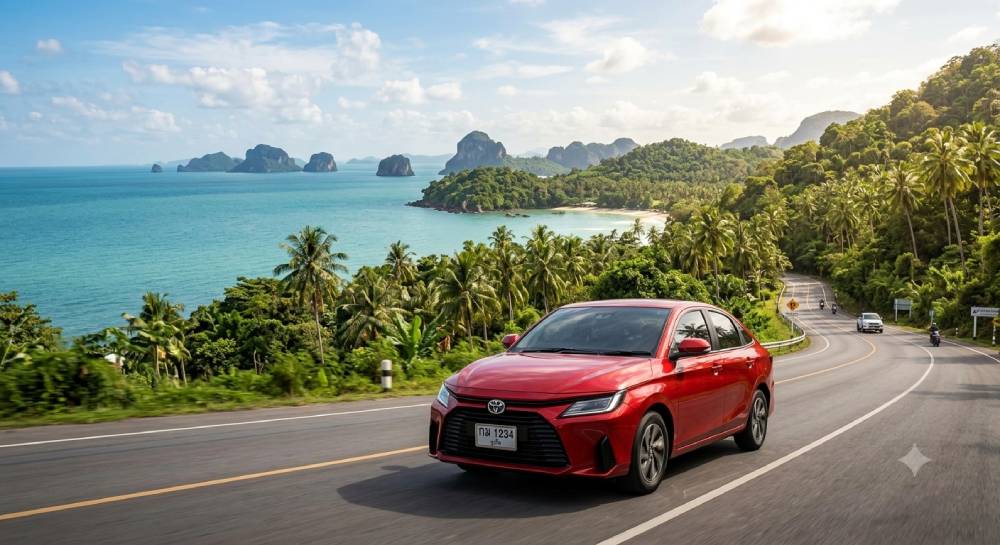
For whom: Couples or small families (2-4 people). Ideal for the "hotel - beach - night market" route.
Pros:
* The lowest rental price
* Penny-pinching fuel consumption
* Easy to maneuver in traffic and park on narrow streets near shopping centers
Cons:
* That very same weak engine
* Low ground clearance - if you decide to turn onto a wild beach along a broken dirt road, there is a chance to leave your bumper in the nearest pit
* Small trunk
Crossover and SUV: the golden mean
For example: Honda HR-V, Toyota Corolla Cross, MG ZS, Toyota Fortuner, Mazda CX3.
If you want more comfort and power, it is worth paying attention to an SUV and a crossover. It is precisely this type of car that many consider ideal for traveling around Thailand. Such options are equipped with engines of 1.5-2.4 liters, which is more suitable for mountain routes. A crossover feels much more confident in such conditions than a regular sedan.
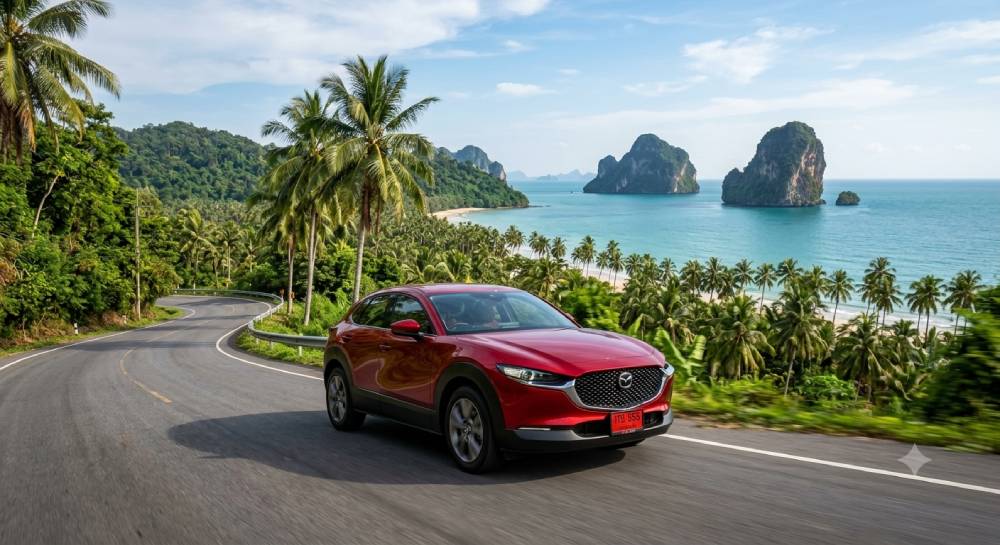
For whom: Groups of 4 or more people or families with a bunch of children's things. For those who love comfort and do not want to worry about the quality of the road surface.
Pros:
* High seating position - the road is better visible, and most importantly, you can not fear the giant Thai speed bumps (they can be harsh here)
* Engines in this class are usually slightly more brisk (from 1.5 L), and all your suitcases and inflatable flamingos will fit into the trunk without problems. But, if you take a Toyota Fortuner SUV with 3 rows for 7 people, then when all rows are up, the trunk becomes simply miniature
Cons:
* Renting will cost noticeably more
* Looking for a parking space in tourist areas will be a little more difficult due to the dimensions
* High fuel consumption
Pickup truck: maximum capacity and local color, for active recreation
For example: Toyota Hilux, Ford Ranger.
In Thailand, especially on the islands, pickups are very popular. Local residents drive them, construction companies use them, and tourists who love activities choose them. If in Europe a pickup is considered exclusively an option for construction needs or transporting various oversized things, then in the land of smiles it is a regular family car. Such cars are excellently suited for trips to less touristy areas, transporting sports equipment, or a large number of things.
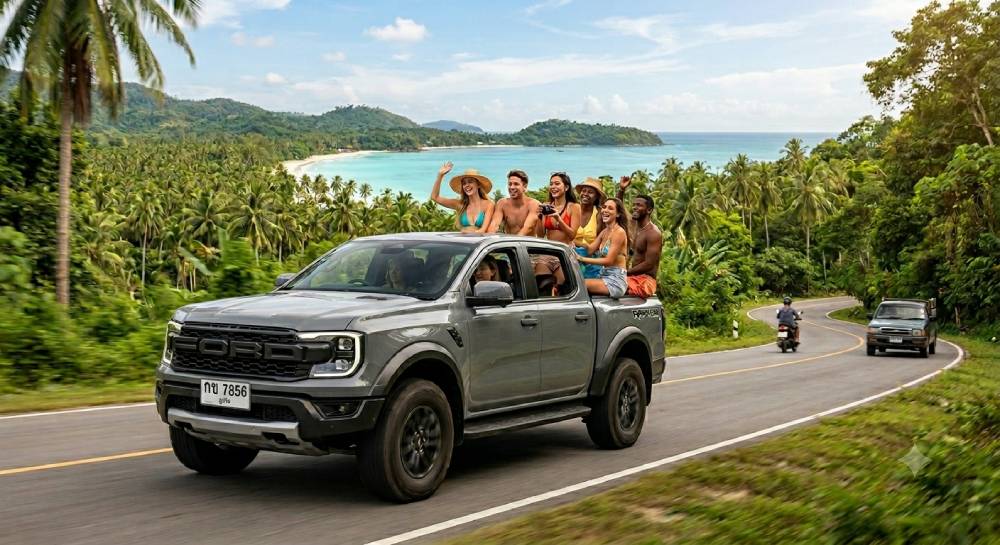
For whom: Large groups, surfing enthusiasts, and those who want to climb into the wildest corners of the islands.
Pros:
* Under the hood there is most often a powerful turbodiesel (2.4-2.8 liters), which will drag you to any observation deck without problems even with a full truck bed of passengers
* Indestructible suspension forgives any pits and stones. And you can boldly throw dirty shoes after the jungle, wet swimsuits, and boards into the truck bed, or seat a large group
Cons:
* This is not at all about comfort and safety
* There is space for up to 4 people in the cabin, so everyone else will have to ride in the truck bed
* Large size. Turning around on a narrow street in Samui is quite a quest
* The suspension is very stiff, so passengers in the back seat and in the truck bed will be shaken quite a bit on bumps
* Riding in the truck bed is very unsafe and uncomfortable in the rain and in the heat
What to choose?
If we speak briefly:
* for the city and economy - a sedan;
* for universal recreation - a crossover;
* for adventures and a large number of things - a pickup truck.
For the majority of tourists who come to Phuket or Samui, the best option will be a crossover. It is comfortable enough for the city, roomy for luggage, and feels confident on the hilly roads of the islands. But if the budget is limited, boldly take budget sedans\hatchbacks. The roads in popular tourist places in Thailand are mostly good, therefore no special problems will arise. The main thing is to choose a car for your recreation style, and not by the principle of "the bigger, the better". Then the journey around Thailand will be comfortable and will be remembered only by pleasant impressions.
Summary: If you are going to the city or to some small islands, there are two of you or a maximum of four, a limited budget, and in the plans there is only smooth asphalt - take a sedan and a hatchback, you will not be mistaken. If you are traveling with a group - overpay for a crossover for the sake of comfort. Well, and a pickup is a one hundred percent choice of adventure seekers!