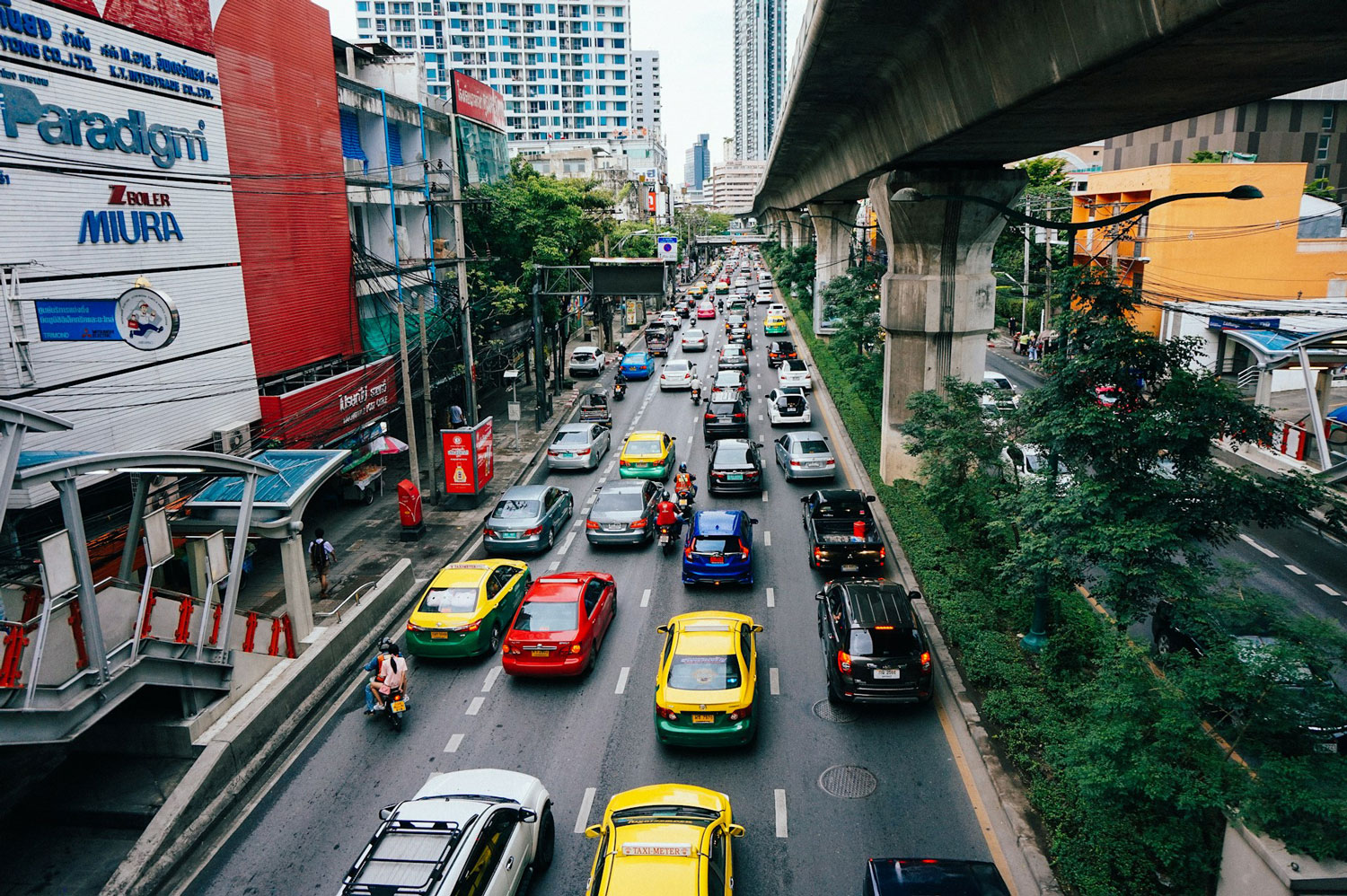
The Kingdom of Thailand is a country with ancient temples, national parks, beautiful sandy beaches and wonderful nature. It is best to rent a car to visit all these beauties. You just don't have enough time on a bus, and there are not public transport in all cities. If in Phuket government more or less start thinking in this direction, then Samui island is in a big trouble at all. A taxi will be too expensive. Driving in Thailand may seem difficult at first glance, especially for an untrained driver who is on the roads of Asia for the first time, but once you understand the specifics of the rules, you will easily master the local roads and become a real Thai driver.
What driving licenses is needed to drive a car in Thailand, Phuket, Samui?
To drive in Thailand, you will need an international license of the appropriate category B, and it is desirable to have a national driver's license with you. The police can ask for both documents, but usually the first one is enough. Yes, you may have heard that the country of smiles has signed the Vienna Convention, but it has not been ratified by the local authorities, so the police do not regard your national rights as a serious document.
Do I need Thai licenses to rent a car in Thailand?
There is a lot of rumors on the Internet that without the presence of local permits you can not rent a car in Thailand. But like most rumors, they're just rumors. If you are a tourist and arrived for a certain period of time, you want to just drive and explore the local sights by renting a car in Phuket, to interact with the police and insurance companies (in case of an accident) you do not need to get a Thai license. It would be enough to have an international version. However, if you intend to stay in the Kingdom and you have plenty of free time (the process of receiving may take several weeks), you can pass the exam and become the owner of the prestigious "plastic" card. You can get permits valid for 2 years with the right to renew under tourist visa.
There are several advantages that Thai driving license give you. Firstly, it allows the extension of national rights when they expire. Secondly, by showing a local driver's license, you can get a discount on entrance tickets to some national parks and attractions. Thirdly, with a Thai license you can freely drive in all ASEAN countries. Fourthly, they can be presented instead of passport on domestic flights or when issuing documents requiring personal identification. And most importantly, the police will respect you. Seeing local rights, they immediately change in the face, become kind. You know for sure you won't get a fine.
In Thailand, left-hand traffic
Basic road rules in Thailand, Phuket, Samui
Most basic road rules are not different from other countries. The main thing to do on the roads of the country of smiles is to be very attentive. Thailand is at the top of the list of the countries with the highest number of accidents on the roads in Southeast Asia. Sometimes it seems that the traffic rules are not observed at all. But it is worth to sit behind the wheel and get into the local engine, you start to feel the other participants of the roads and understand that everything is not so scary. The main thing is not to speed up to have time to stop in time or to make a maneuver and escape from the collision.
Here are the basic rules:
On a crossroads you can turn left on a red light if you do not interfere with other participants and/or if there is a sign. But if you are not sure if you can turn or not, it is better to wait for the green color.
At a T-shaped intersection it is permitted to drive directly on the left strip to the red light of the light if you do not interfere with other participants in the traffic and/or if there is a corresponding sign.
Observe the speed mode. There are cameras on many stretches of road in Phuket and Samui. There is a 500 baht fine for speeding.
You can cross the yellow solid dividing line, of course letting all other drivers pass.
If you want to be passed, blink your headlights. If you see in your rearview mirror that someone is blinking at you, let them pass if possible. Otherwise, he will overtake and create an emergency situation.
When driving on a roundabout, the priority is given to the one who is already on it. Thais very often "forget" about this rule and drive as they want.
If a situation arises where you need to stop abruptly, turn on your emergency lights. The car following you will not overtake and will not create an emergency situation.
In the cities of Thailand it is allowed to speed up to 80 km / h, outside the city up to 90 km / h, and on the highways up to 120 km / h.
Signs on the roads are duplicated in English so that foreign drivers can understand their meanings.
The larger transport you have, the higher the priority status you have on the road (but for the police in case of an accident of course not). It applies not only to buses or trucks, but also to private cars. For example, a large Toyota Fortuner SUV will be passed faster than a small Suzuki Swift. This can also include the rule "the more expensive the car, the more cocky I am on the road". Mercedes-Benz will never stand on a corner waiting for an opportunity to slip through traffic. It either gets a cheeky start or is very quickly passed by others.
Deceptive turn signals on scooters. If you see a turn signal on, don't believe it 100%. It was simply forgotten to be turned off. Drivers can drive all the way with the signal on, but never turn anywhere. And sometimes they turn in the opposite direction.
It is not necessary to turn on the headlights in the daytime. You may meet especially "thrifty" citizens who do not turn on the lights until dark. And all because there is an opinion that headlights "consume" a lot of gasoline.
You can overtake only on the right, but on Thai roads you should never relax and always check both sides.
In Thailand, is the obstacle on the right or left?
There is a lot of debate on this issue. In fact, there is no such concept in the local traffic rules at all. Many information sites claim that in Thailand there is interference on the left, because the traffic is left-handed. However, both rules work here. It all depends on the specific case. Interference on the right in Thailand also takes place and is "turned on" at intersections when you turn right or left: in this situation you must let those who drive on your right. For oncoming traffic, the obstruction is on the left: those driving on the oncoming side of the road have priority, then you turn. At equivalent intersections, you give way to the person on the right of your vehicle. In reality, everyone acts intuitively. Who is in a good mood, and he and misses. Always remember that the other driver may not know the traffic rules or simply does not want to comply with them. Remember about the local peculiarity of driving "who is bigger or "more expensive", the one who is right".
Parking where you can leave your car
As for parking in Thailand, then on forums where tourists actively communicate, you can often find information that there are no parking rules at all. They say that you can leave the car wherever you want. However, this is not entirely true. In Phuket and Samui it is quite often possible to meet blocked wheels of improperly parked vehicles. In this case, the violator will need to come to the police station of the area where he left his iron horse and pay a fine. The fine is usually 500 baht, or you can send a Thai friend to "knock out" a discount."
Parking rules in Phuket and Samui are quite simple and easy to follow:
You are not allowed to park at bus stops (yellow and white curb markings), near intersections and on bridges.
Red-and-white curb markings also signal that parking is prohibited at that location.
Watch for parking signs. There are various signs: somewhere parking is allowed only on weekends, somewhere at certain times.
Pay attention to the parking lots of cab drivers. As a rule, there is a sign with the inscription of a taxi or just stands a lot of taxi cars. They don't like strangers taking their spots. They can cause damage to your vehicle, and the responsibility will fall on you if you rent a car. Insurance will not cover the damage in this case.