
When planning a vacation in Thailand every traveler is puzzled by the question of "how to get around" and faces a dilemma: trust local taxi drivers or take matters into their own hands. While it seems simple, in practice the difference in convenience, cost, and travel experience can be enormous. It all depends on your itinerary, budget, and travel style. Car hire in Thailand takes travel to a whole new level. You're no longer just a tourist tied to a hotel and become a true explorer. Having your own vehicle means independence. This option is especially relevant on Koh Samui and Phuket, where the most picturesque viewpoints and secret beaches are scattered far from each other, and public transportation is underdeveloped.
Transportation is a pressing issue throughout the country. Perhaps only in the capital, Bangkok, is it more or less possible to live "without wheels." In recent years, Phuket authorities have been focusing on developing bus routes and even planning a tram line, though it will likely remain just a concept. But on Koh Samui, things are truly dismal, and walking is downright uncomfortable. Although the island is only 60 km in circumference, the mountainous terrain and constant heat of 30°C (86°F) make it difficult to walk far. The situation is further complicated by the lack of sidewalks in 80% of the resort. If you don't want to spend your entire vacation confined to your hotel, you'll have to consider renting a vehicle or taking a taxi.
In this article, we'll provide a detailed comparison of car hire and taxis, presenting real figures, highlighting potential pitfalls, and offering recommendations to help you choose the best option for your vacation.
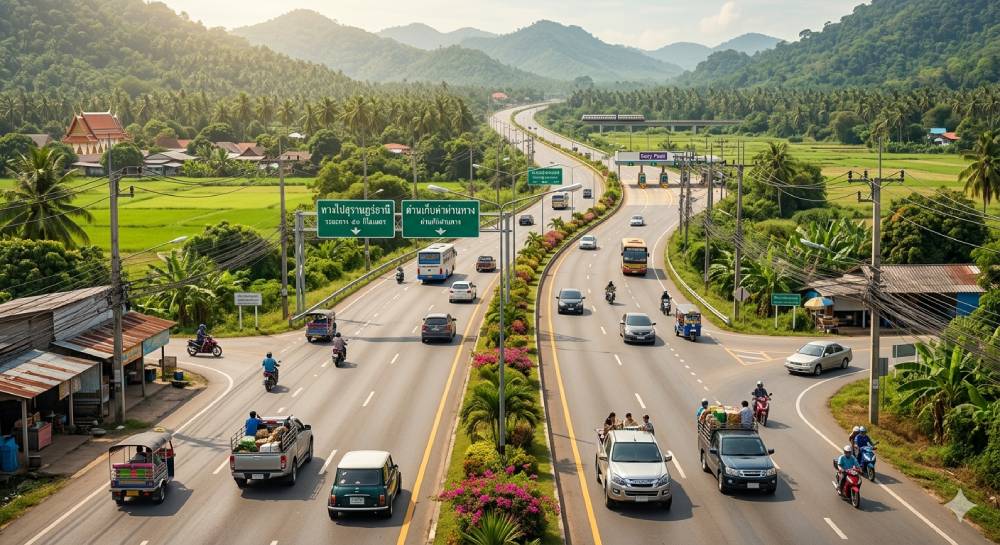
A Car hire in Thailand: Freedom or Headache?
Renting a transport means comfort (air conditioning is invaluable in 35°C) and mobility. You don't have to wait for a driver or haggle on the side of the road. It's one of the most popular modes of transportation among tourists who want freedom and flexibility.
How does renting work?
You book a car online or on-site, pay a deposit, and get a transport for the desired period-from 1 day to several months. The selection of cars is quite large-it all depends on your preferences and budget. For solo or couple travelers, budget sedans and hatchbacks like the Mazda 2 and Suzuki Swift, or slightly more powerful Toyota Vios or Honda City are suitable. Families will appreciate spacious minivans for up to 7 people. Those who prefer comfort and safety should consider the premium segment of the Toyota Altis, Toyota Camry, Mazda 3, or crossovers like the Toyota Cross, Mazda CX30. And of course, let's not forget the large SUVs for large groups or well-heeled drivers like the Toyota Fortuner and Mitsubishi Pajero Sport. Young people will love the roofless Wrangler SUVs. However, be careful with them, as their technical condition is not always up to par.
Pros and cons of car rental
Let's start with the benefits
1. Complete freedom of movement
You build your own route:
* you can drive to a wild beach
* stop at any cafe along the way
* change plans at any time
This is especially important on islands without public transportation. You can hit a secret beach at dawn, when taxi drivers are still asleep or charging double, drive around the entire island, or head into the mountains to see waterfalls where taxi drivers simply refuse to go.
2. Saving money when traveling actively is probably the main benefit.
If you are planning:
* more than two trips per day
* long-distance travel
* island exploration
In such situations, renting a car is always more cost-effective than taking a taxi. If you plan to leave the hotel every day (to go shopping, to dinner, to different beaches), a car pays for itself immediately, especially if there are more than two people.
3. Comfort and privacy are no less important pros.
* air conditioning is always with you
* no need to wait for the driver
* you can leave your things in the car
* Ideal for families with children. It's much easier to load a stroller, inflatable rings, and bags of fruit into the trunk than to try to fit all of this equipment into a tuk-tuk. A very small percentage of taxis provide child seats.
*protection from sunburn and minor accidents, unlike riding a scooter.
A car is your fortress. It has air conditioning, a roof over your head during the rainy season, and airbags, which is very important, as accidents are common on the roads in Thailand .
4. Access to non-tourist and hidden places
Many locations:
* hidden beaches
* observation decks
* jungle and waterfalls
are only accessible by private transport and you will unlock these routes by renting a car.
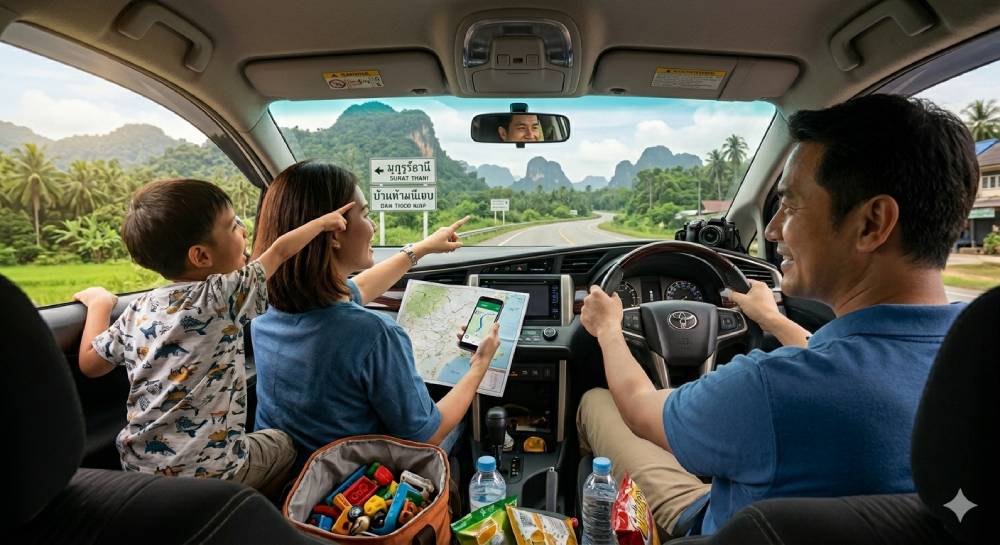
Disadvantages
1. Left-hand traffic: It takes time to adapt. This may be a major disadvantage for someone. Drivers from left-hand drive countries will find it difficult and unusual at first. Don't rush into the main traffic right away; practice on smaller roads first.
For beginners this is:
* stress in the first days
* errors at intersections
* confusion with turns
Local driving style can also be a cons of car hire. The roads are full of scooters, which can overtake from any direction, drive erratically, and don't follow traffic rules.
2. Traffic and Parking: In Phuket, especially in the Patong area, finding a parking space is a real quest. You'll pay fines for illegal parking or traffic violations. In Bangkok, you'll spend most of your trip stuck in traffic.
3. Documents: To drive a car, you must have an International Driving Permit (IDP) with an open category "B." You can rent a car in Phuket or Koh Samui with just your national license (but with an English translation required), and car insurance will be valid in the event of an accident. However, the police require an IDP. The fine for not having one is 1,000-2,000 baht. This is an unpleasant disadvantage. It's worth noting that cars are rarely stopped. Traffic police mainly target scooter drivers without helmets and licenses. This, by the way, is an undeniable benefit of renting a car.
4. Deposit and liability for other people's property. Most rental companies require a cash deposit. A small percentage will take your passport as a deposit, but this is a worse solution than cash, as in the event of a dispute, you risk losing an important document and will do anything to get it back. To protect your deposit, before signing the contract (which you should, of course, read and understand the terms of the deposit refund), you must carefully inspect the car for any damage, both inside and out, and document it with photos and videos. Failure to do this will result in any scratch, even an old one, being charged to your account upon return. And without photos, you won't be able to prove it was there before. To avoid this, choose your car rental service in Thailand responsibly and read reviews.
International car rental chains freeze the deposit on your credit card and only return it a month after the rental ends, which is a distinct disadvantage and cons of such services. Local small businesses allow you to leave a cash deposit (not only in local baht, but also in the equivalent in dollars, euros, and even rubles) and return it the same day you return the car, which is certainly a benefit and advantage. The deposit amount varies from $100 to $700, depending on the company and the car.
Real rental price
Thailand is a large country with numerous provinces and cities. Each city has its own pricing policy. Naturally, rental prices depend heavily on tourist flow, and the more popular a destination is, the higher they are. Currently, Phuket remains the leader, with Koh Samui and Pattaya tied for second place, followed by Bangkok, Chiang Mai, Krabi, and others. Southern resorts with their sea and beaches are, of course, the most popular among travelers.
So, prices depend on the region and season. The most expensive times are New Year's and Christmas: from December 23rd to January 5th, prices skyrocket. But demand is still insane. Even the most run-down rentals, ones that have been sitting in a garage under a meter of dust all year, are being sold. And they're still taken, as there are more people willing to rent than actual inventory. The cheapest season also depends on the resort. For example, in Phuket, it's summer and fall, as this is the time of rain and big waves, and tourists won't even be tempted by the fruit, which is just ripening. On Koh Samui, there's no clear seasonality; you can visit year-round. Summer and fall, on the other hand, have excellent weather, but the monsoons arrive from November to January, just as the monsoons leave Phuket. But despite the wet weather, New Year's Eve is still on offer. So, come rain or shine, prices still rise. It's safe to say that prices on Koh Samui are more or less stable year-round.

How much does it cost to rent a car?
In addition to the time of year, the price also depends on the car itself (its class) and the rental period. The longer the rental period, the lower the daily price. Rentals are calculated in full days, not days. For example, if you rent a car at 10:00 on the 10th and return it at 10:00 on the 11th, any increase in the hourly rate is reflected in the price. Typically, 5+ hours are considered a full day.
* Economy class - the simplest and most popular options for up to 5 people (Toyota Yaris, Suzuki Swift, Nissan Almera, Honda City, Mazda 2...): daily 500-1500 baht / day. Monthly 10,000-20,000 baht.
* Premium and comfort (Toyota Camry, Honda Civic, Toyota Altis...): daily 1,600-3,000 baht/day. Monthly 19,000-30,000 baht.
* Crossovers and SUVs (Toyota Fortuner, Honda HR-V, Mazda CX3...): daily 1,500-3,000 baht/day. Monthly 21,000-45,000 baht.
* Minivans for up to 7 people (Toyota Veloz, Mitsubishi Xpander, Toyota Sienta...): 1,100-2,500 baht per day. 25,000-35,000 baht per month.
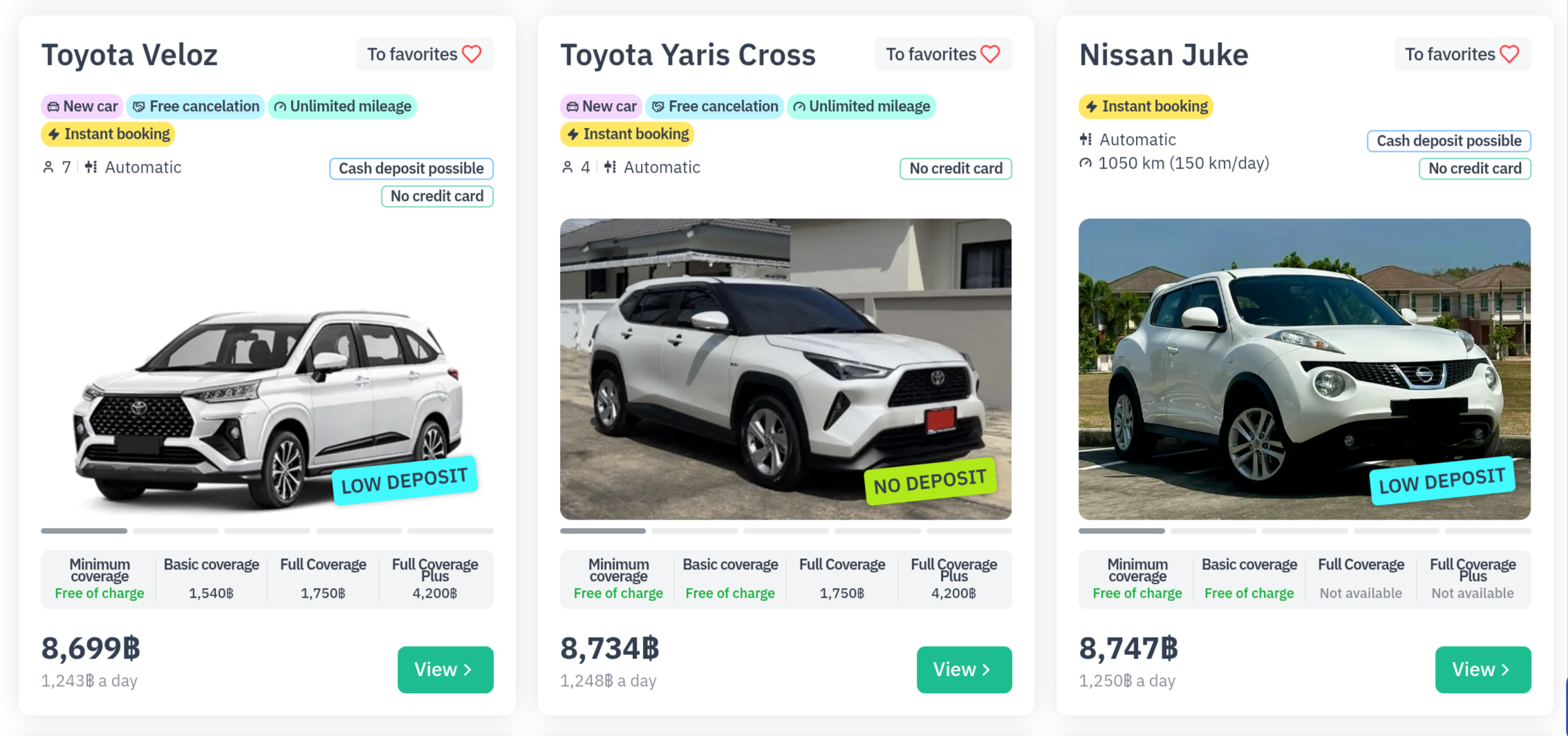
* Additional costs:
Gasoline is 35-45 baht per liter. Fuel prices also vary depending on the resort. It's cheapest on the mainland. It's 0.5 baht/liter more expensive in Phuket, and 1.5-2 baht/liter more expensive in Koh Samui.
-Refundable deposit: 2000-20,000 baht in cash or by blocking your card (never leave your passport as a deposit!).
- Insurance. In most cases, car rental insurance in Thailand is included in the price, but with a deductible (a certain maximum amount of the renter's liability for any damage). Some companies offer the option to purchase an extended policy for an additional fee. This increases the daily cost of the car by 100-200 baht.
-Child seat rental if needed: 50-200 baht per day or free depending on the company.
-Other accessories - camera, navigator, phone holders, etc.
Taxi in Thailand: Comfort without obligation
If you're planning a vacation in Phuket or Koh Samui and want to spend most of your time near one beach, only occasionally heading out for dinner, a taxi might be a smart choice. It's the easiest way to get around, especially for first-timers or those who are apprehensive about driving in a new, unfamiliar country. If you've come to Thailand for complete relaxation and plan to shuttle between sun loungers, massage parlors, and restaurants, renting a car can actually be a chore. Constantly wasting time looking for parking and worrying about what might happen is not a great vacation. Both on the mainland and on the islands, taxi booking apps like Grab, Bolt, and InDrive work well. In large cities like Bangkok, a taxi is a real escape from the stress of driving, allowing you to simply relax in the back seat.
What kind of taxis are there in Thailand?
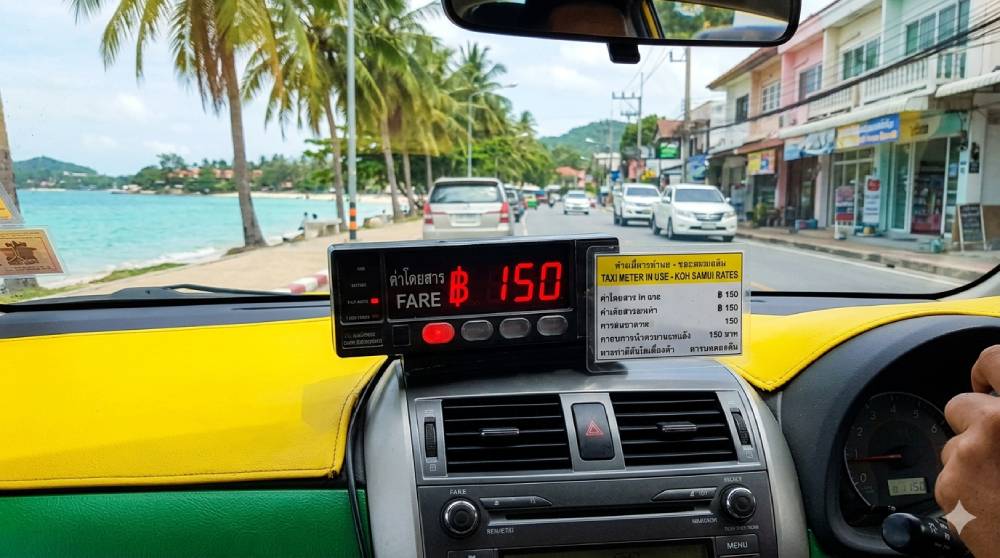
The most common type is tax-metersi. These colorful cars ply the city and can be hailed the old-fashioned way, by holding out your hand. There's a key caveat: always agree on a fare before the ride and check that the meter is on. Taxi drivers often drive without one, and the fare can be quite expensive. This is the most common type of taxi in Bangkok.
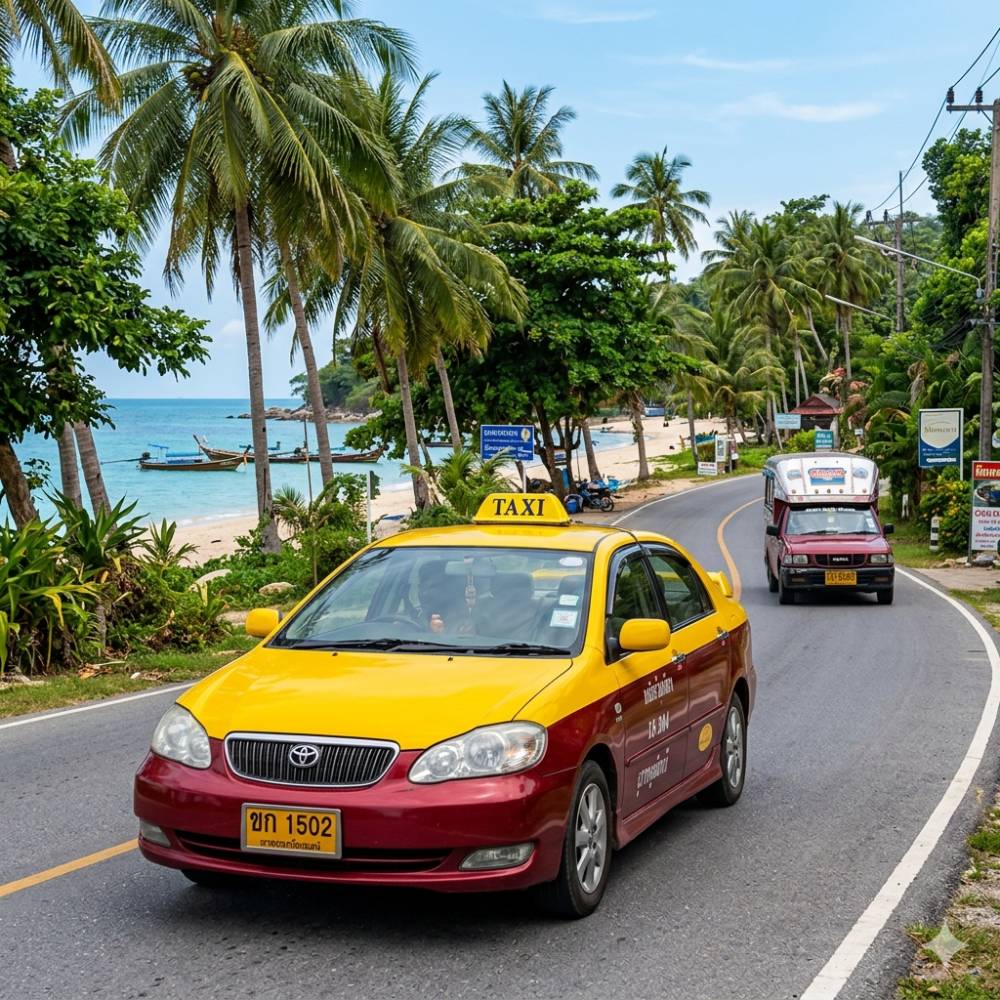
The following applications work in the same way:
Grab: The most popular, but often the most expensive. There's an official counter at Phuket Airport.
Bolt: Grab's main competitor with lower prices (especially in Phuket).
inDrive: Allows you to offer your own price for a ride, cheaper than the previous two and more popular on Koh Samui.
No matter how high their price, it will still be 2-3 times cheaper than a taxi, especially on Koh Samui: the local taxi service is probably the most expensive in the entire country, and the island is much smaller than Phuket or Bangkok.
Comparison of Phuket vs. Koh Samui
Transport policies at these resorts vary greatly.
Phuket is an island of great distances. There are several major roads and many smaller ones. The drive from the airport to the south of Nai Harn Island is about 50 km and takes about 1.5 hours. In normal traffic conditions, congestion is common, especially during rush hour before 9 in the morning and at 5-7 in the evening.
Taxis are very expensive compared to, say, Bangkok or Pattaya. The local taxi mafia keeps prices high and prevents apps from operating properly. Near popular tourist spots and some large hotels, they have a complete monopoly, forcing app drivers to pick up passengers in a separate area near the main entrance, away from the eyes of taxi drivers. For example, if you call a car to the airport, the app driver will likely ask you to step outside the airport's premises before picking you up. No private driver will drive directly to the airport for fear of the taxi mafia. It sounds like a plot from a Western, but unfortunately, it's reality. Taking a taxi is convenient and affordable if the trip is a one-off and not long.
Renting a car is ideal if you want to visit a large number of attractions and plan to leave your hotel several times a day.
Samui is a ring road island. It's more compact, with only one main ring road and several smaller roads inland. You can drive around the entire island in an hour. Traffic jams are almost nonexistent, except for accidents or rush hour. But even if there is a traffic jam, it doesn't last long.
Taxis on Koh Samui are considered among the most expensive in Thailand. Meters are rarely used here, preferring fixed prices. Grab and InDrive apps are available. The taxi mafia situation is the same as in Phuket.
Car rental in Samui is ideal for visiting the waterfalls and temples in the center of the island. The roads are narrower than in Phuket, but the traffic is calmer.
Taxis in Thailand: Pros and Cons
Advantages
1. Lack of responsibility
You don't have to worry about parking, traffic rules, possible scratches on your bumper, or dealing with the traffic police, which is undoubtedly a major advantage, as you want to relax on vacation.
2. Convenience and accessibility
Wide selection, easy to find without long waits. A major plus – no one wants to waste precious vacation time.
In Thailand, Grab, Bolt, and InDrive are all great apps.
You see the price in advance, the route is built using the navigator, and you can pay by card (in the app) or in cash without haggling.
3. No need to drive yourself
Ideal for those who don't want to take risks on the roads.
4. No stress
No need to monitor the navigator, look for parking at crowded markets, or worry about the safety of your car.
5. Freedom of action
You can indulge in a cocktail with dinner or an ice-cold beer on the beach without worrying about getting to your hotel, which is a definite pros and advantage, as drinking alcohol while driving is prohibited, and a vacation without a drink isn't a vacation.
Disadvantages
1. High cost for frequent travel.
When you're on an active vacation, expenses can mount quickly. The taxi mafia often dictates its terms. A trip to a neighboring area on Koh Samui can be unreasonably expensive compared to the mainland. Every traveler strives to find the most economical solution for their budget, and high taxi prices are definitely a disadvantage.
2. Problem with remote locations and time
Taking a taxi to a popular shopping mall is easy, but getting a ride back from a remote jungle waterfall or a hard-to-reach beach can be challenging. Not all drivers know the secret spots, and it takes time to explain the route. Taxis operate on a schedule, making it nearly impossible to get a ride late at night or at night, which is certainly cons.
3. Dependence on drivers
They may overcharge. They may refuse to go. Sometimes you have to bargain.
4. Waste of time
Waiting for a car. Traffic jams. Searching for transport in the evening or at night and during rush hour.
5. Language barrier with street drivers
If you hail a taxi on the street, the driver may not know English or may try to drive without a taxi meter, quoting an inflated price.
6. Human factor
You never know who you're getting into a car with. Although Thailand is relatively safe, crime exists, and like anywhere else in the world, unpleasant situations with passengers do happen, and you should always be on guard.
Real taxi prices
The price range between the mainland and the islands is huge.
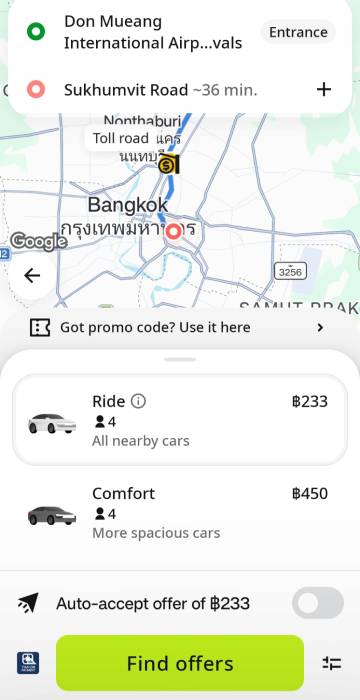
Bangkok (Taxi-Meter): Pickup is 35 baht (includes the first kilometer). After that, it's about 6-8 baht per kilometer. An average 5-10 km trip within the city costs about 100-200 baht. The cost through apps is almost the same.
Samui, Phuket
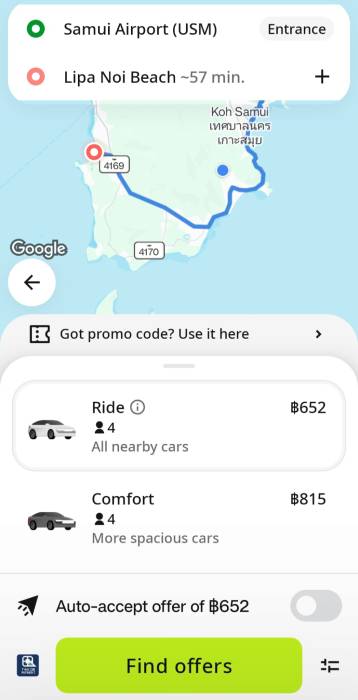
Prices are set by the local taxi mafia. Even a short trip (for example, 5-7 km between neighboring beaches on Koh Samui) can cost 500-600 baht one way.
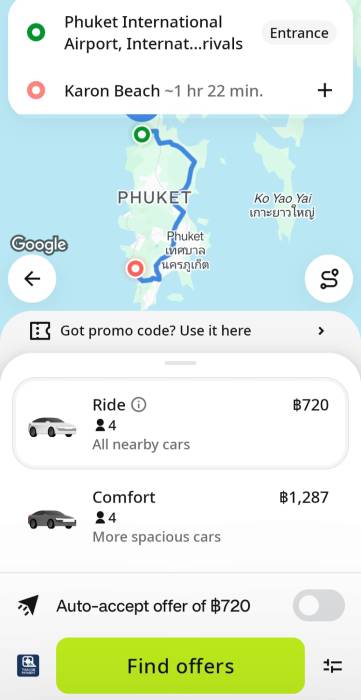
The trip from the airport to the hotel on the island will cost 500-1000 baht, depending on area.
In Phuket and Samui, it is more profitable to use apps.
Average rates:
* short trip: 35–300 baht
* average trip: 300–800 baht
* long trip: 800–1500 baht
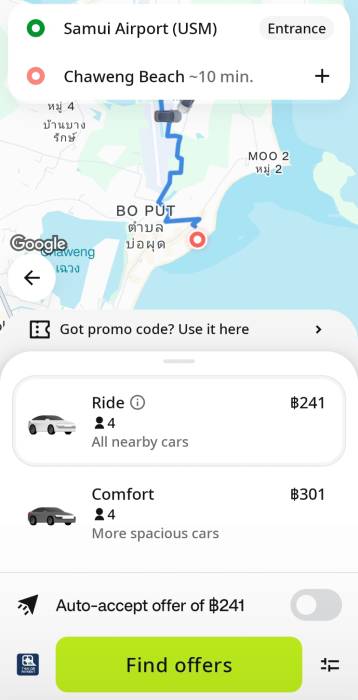
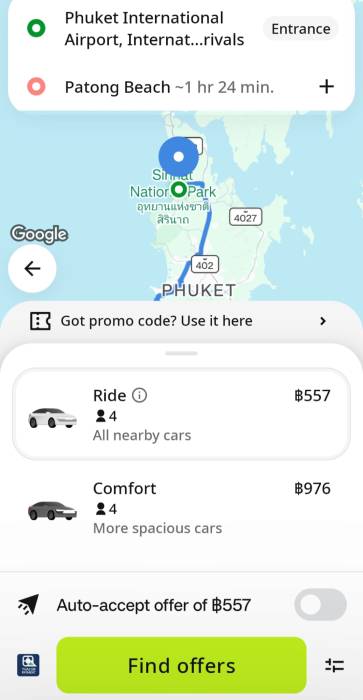
Choosing a Taxi or Rent a transport: Real-World Examples and Scenarios
Scenario 1: A family of 3-4 on vacation in Koh Samui for a week
Plans: Go to a large supermarket, visit an elephant sanctuary, have dinner at one of the restaurants in Fisherman's Village and see 3 popular beaches.
By taxi
Each roundtrip will cost between 400 and 1,200 baht. Over the course of a week, this adds up to a hefty sum of around 7,000-8,000 baht.
By rented car:
Hire an economy class car for a week costs approximately 6,000 baht plus 1,000 baht for gas. It's comparable in price, but you get unlimited freedom and save a ton of time waiting for taxis, especially if you have small children, as not all taxis provide child seats.
Scenario 2: A couple on vacation in Phuket for 14 days
Plans: to travel around the entire island, only staying overnight in the hotel.
Taxi
300-800 baht for a one-way trip = minus 2000-7000 baht at the end of the day
Car rental
Budget option 8000-9000 baht for 2 weeks + 1000-2000 baht for gasoline.
The savings are obvious.
Scenario 3: A 10-day relaxing holiday in Phuket or Koh Samui
The plan is to spend all your time on the nearby beach, have dinner near the hotel, go on ready excursions, and perhaps visit a couple of attractions on your own.
In such a scenario, of course, hire a vehicle would be unnecessary and even burdensome, but spending 1,000 baht on a taxi for the entire vacation is quite tolerable.
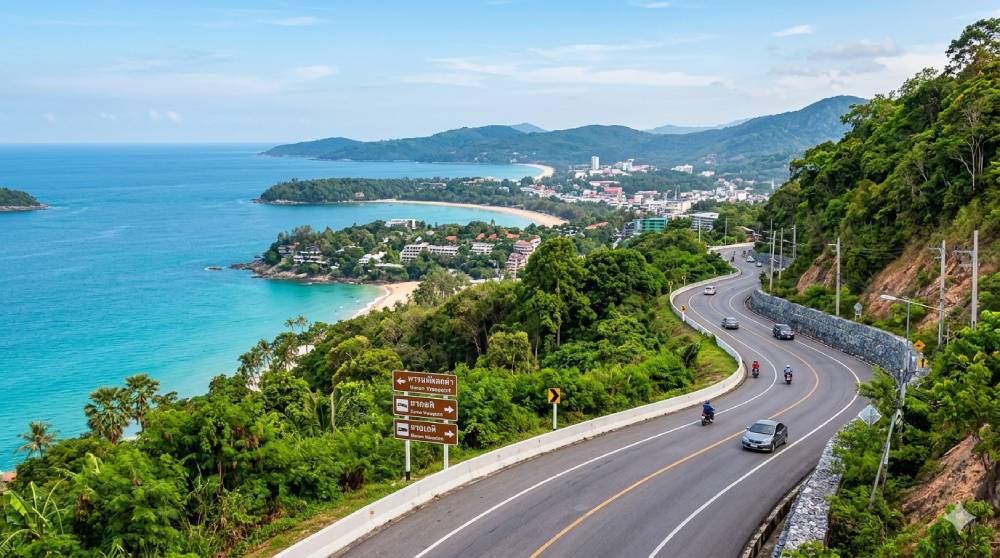
Let's sum it up
What to choose: a taxi or hire a vehicle
There's no one-size-fits-all answer to the Land of Smiles. Everything depends heavily on the resort, your plans, and even the time of year you visit. But you're 100% guaranteed to get what you want if:
Rent a car :
*long vacation
* want freedom of movement
* plan to travel a lot
* traveling in a group
* you are on holiday with small children
Choose a taxi :
* short rest
* don't want/are afraid to drive
* you move around little
The more active you travel, the more profitable it is to rent a car.
The more relaxing the holiday, the more convenient the taxi.
Car rental is the best choice for active travelers and families with children.
Taxi is a convenient option for short trips and lazy relaxation.
Important tips:
If your choice is a car hire
* Book only with trusted companies, read reviews
* Take photos of the car (inside and outside)
* Carefully read the contract, especially the clause regarding your financial liability in the event of damage or accidents. It should be in English or Thai, but with a translation. Never sign anything you don't understand.
* Check for insurance
* Do not leave your passport as a deposit
* Observe traffic rules and parking regulations
* If possible, pay a deposit in cash
* Specify your actions in case of an accident or other unforeseen situations
* Be careful with scooters. They are the main cause of accidents.
If your choice is a taxi:
* Use apps - cheaper, more convenient and safer
* Check the price in advance and make sure the meter is on (if you are using a taxi-meter)
* Avoid "private sellers" without an agreement