
Planning a trip to the Kingdom of Thailand inevitably confronts vacationers with the harsh reality of transportation. Buses and the metro operate only in the capital. Pedestrian infrastructure is virtually nonexistent: sidewalks are rare or nonexistent, often cluttered with haphazardly placed utility poles, food stalls, or parked vehicles, forcing pedestrians to maneuver across the road. In the oppressive heat of 35°C (95°F), even short walks become an ordeal. You'll never want to leave your hotel. In regions like Khao Lak and Phang Nga, stretched out along wide coastal roads, the lack of on-site or public transportation literally traps travelers within their hotels or forces them to spend money on unaffordable taxis. Phuket, with its towering mountain ranges and winding roads between beaches, also doesn't make life any easier for visitors.
When you arrive in Thailand, it seems like everyone is riding scooters. They're parked outside every store, near beaches, cafes, and even local grandmothers have one. For Thais, it's the norm. They start riding motorbikes as young as 12 (or even earlier) and ride them until their last breath. And seeing all this, tourists think scooters are incredibly easy to operate, since even children can do it.
You start wondering which transport is better: a fast, maneuverable motorbike, a budget-friendly but far from safe one, or a car? Especially if you're traveling with your family.
In this article, we'll compare a motorbike and a car-which is more cost-effective, safer, and more convenient. Ultimately, the decision is yours.
Two-wheeled romanticism versus harsh reality
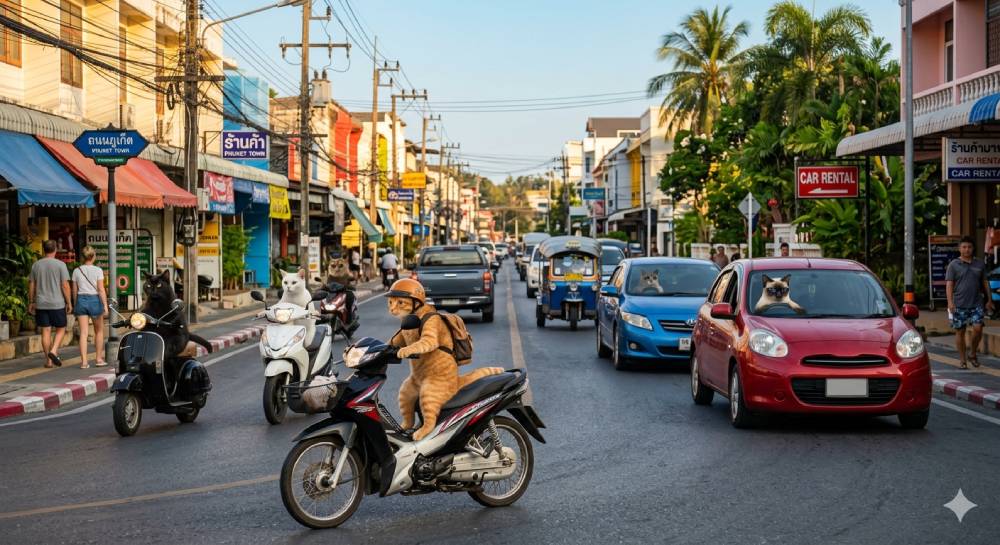
Images on social media often create a romantic atmosphere around scooter riding in Thailand: the wind in your hair, freedom of movement, and endless deserted roads. However, reality shatters these illusions. Thailand consistently leads the rankings for the number of road accidents and fatalities in all of Southeast Asia, specifically due to scooter accidents. Most tourists are riding a motorbike for the first time, often without understanding the physics and specifics of its operation. Many underestimate the technical difficulties of operating a two-wheeled vehicle. In the popular tourist resorts of Phuket and Koh Samui, a motorcycle is almost an extension of a person. Everyone rides them everywhere: tourists, locals, food delivery people, children and pets, and even large items like refrigerators and televisions. Locals sincerely believe that a motorcycle is a miniature car.
Pros and cons of a scooter
Why do so many people choose it? The main advantage is freedom. You don't get stuck in traffic, which is important in big cities with heavy traffic. Parking is easy, and you can go places where a car simply can't. On the islands of Koh Samui, Koh Phangan, or Phuket, a bike feels absolutely perfect. Riding along the sea, the wind, the palm trees-a real vacation vibe.
Another huge pros is the price. Hire a scooter is usually cheap, and gas is also cheap. Compared to a car, the savings are significant. Buying a two-wheeled "friend" is also much easier on the wallet. For example, a Honda Click—the most popular scooter-costs around 50,000-70,000 baht, and a used one is even cheaper, compared to the most budget-friendly option, which costs 500,000-600,000 baht. Long-stayers often buy used motorbikes, as they are cheaper than renting. Rental costs are 150-500 baht per day for daily rentals, and 2,500-4,000 baht per month for long-term rentals.
But there are also downsides
The biggest one is, of course, safety. The roads in Thailand are incredibly chaotic in places. Furthermore, driving on the left is unusual, and can be confusing at first, and after rain, the hot asphalt becomes as slippery as a skating rink.
If you're new to riding a bike, the first few days will be stressful and dangerous, especially in large cities and tourist areas where traffic is quite heavy. Generally, if you're riding a two-wheeler, or any other vehicle, for the first time, the risk of getting into an accident increases dramatically. It may seem easy to ride, no more difficult than a bicycle, but the reality is quite different. If you don't understand the physics and specifics of riding a bike, the outcome will be disastrous.
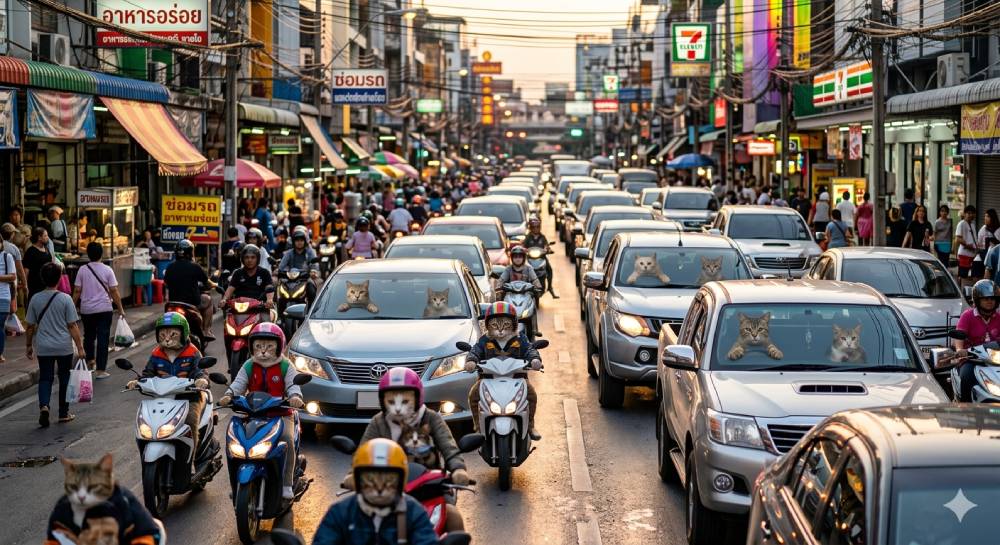
Small size. On the Kingdom's roads, an unspoken rule of "bigger is boss" prevails, leading cars, especially trucks and pickups, to almost never yield to scooters. Consequently, scooters squeeze between cars, cut in from the sides, and constantly try to overtake, increasing the risk of collisions. Furthermore, local drivers often ignore yellow traffic lights, speeding at intersections, and ghost riding is considered commonplace.
Driver license and fines. According to Thai traffic regulations, a category A driver license, ideally an international one, is required to operate a motorbike. However, rental companies often rent out vehicles without any license at all or with just a car license. This is, of course, a traffic violation, and the police know this, so they raid the area several times a day and collect fines from violators. It's a good thing you get off with just a fine. It's worse if your poor driving skills land you in the hospital. Not having the required driver license completely voids your health insurance, leaving you with huge bills. In local social media groups, mornings begin not with coffee, but with a cry for help and a fundraiser for medical treatment after an accident.
No insurance. Motorbikes are uninsured, and if you cause an accident (and beginners often fall and lose their balance), you'll pay twice: to the other party involved and to the rental company. Cars are fully insured for this. Even if you have insurance with a deductible, which is common in Phuket and Koh Samui, your liability is limited to that amount. You know what to expect, but no one knows how much someone who's injured by your scooter will charge. It could be a minor scratch, or it could require major repairs. For example, repairing a single part will cost around 2,000-5,000 baht, depending on the severity of the damage.
Passport as a deposit. On Koh Samui and Phuket, the collateral issue is acute: large companies never accept original passports as a deposit, while private street rentals often try to manipulate tourists by withholding documents. Some people, on the other hand, are happy not to have to leave money and readily hand over their passports, but they overlook an important detail: in any dispute when returning the vehicle, they will be trapped and will accept any terms to get their passport back.
Also, a scooter is not quite a suitable option:
- if you are with children;
- if there are a lot of things;
- if there are tropical downpours;
- if you need to travel far.
And yes, there's no air conditioning either. At +35 degrees, not only does your head get baked, but the seat gets incredibly hot.
Four-wheel comfort: protection from the elements and heat
A car in Thailand, especially on the islands, is often perceived as unnecessary transport for conservative tourists. However, in the tropical climate, it is a key guarantee of safety and stability. The main advantage is air conditioning. Riding in the scorching sun quickly exhausts scooter riders, while car drivers retain their energy and vigor for an evening out.
Pros and cons of the car
A car in Thailand is all about comfort. Get in, turn on the air conditioning and music, and drive calmly, whether across the city, between provinces, or to the nearest store. Neither heat nor rain are a problem. A car driver is protected from the vagaries of the weather and can safely continue to their destination even after a sudden downpour, while a motorbike rider must stop and wait out the storm.
And in the event of an accident, the iron walls and airbags will protect you. In my opinion, that's the biggest advantage. It's not for nothing that a car is called an iron friend.
When the car actually wins
If you are traveling with a group or family.
Safety. Don't look at Thais who transport their children on scooters, holding the handlebars with one hand and the child with the other. This is not a good example.
Convenience. You can easily load suitcases, groceries, children's clothes, and inflatable rings without worrying about how to transport it all on a bike.
Comfort. A family or group of four or more will hardly fit on a motorbike. But if you're vacationing with friends, the rental cost can be split between everyone, resulting in a price that's almost the same as a scooter, only much more comfortable and safer.
A car is also a lifesaver during the rainy season. When a real tropical downpour hits, bikers look like they're part of an extreme show. But in a car, you just keep going.
A car is also much better for longer trips. For example, if you want to explore northern Thailand or ride between the different beaches of Phuket. After an hour on a scooter, your buttocks turn to stone, and you really want to stop the ride and lie down in a soft bed.
Disadvantages of the car
Of course, we can't do without them either.
First, parking. In tourist areas, it's sometimes easier to find gold than a free space. This is especially true on Koh Samui. The island is small, the roads are narrow, and there are a lot of people, but not a lot of space. Read about parking on Koh Samui here .
Second - traffic jams.
In Bangkok, Pattaya, and Phuket, they can be very harsh. You can instantly lose 2-3 hours of your life.
Third, the price.
Rent, gas, and a security deposit are usually significantly more expensive than for a scooter. Rental prices vary depending on the model, brand, class, year of manufacture, and season. Approximate prices: 500-3,000 baht per day for a daily rental, 10,000-40,000 baht per month for a long-term rental. The security deposit is 2,000-15,000 baht.
Well, you also need to get used to driving on the left side of the road.
What else is important to know
Geographical traps of islands.
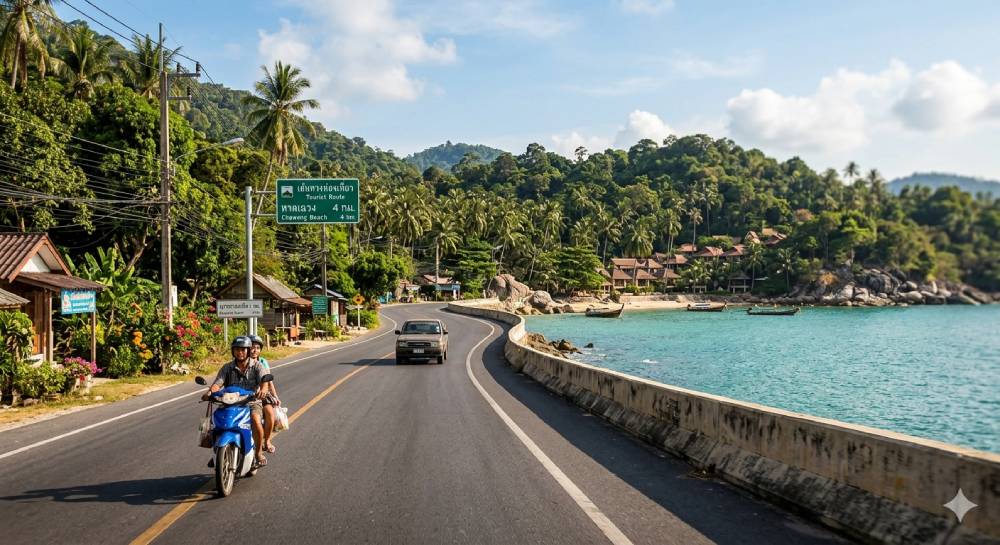
Phuket is a large island with a distinct mountain range. Trips between the west and east coasts are steep, switchback roads where a low-power scooter is at risk on climbs and easily overheats the brakes on descents. Koh Samui, by contrast, is encircled by a ring road with small mountain ranges, but exits lead onto dirt roads, gravel, and dangerous sand. The island even coined the term "Koh Samui tattoos" – abrasions and burns that almost every other inexperienced motorbike rider ends up with after overestimating their strength and the grip of their tires on the sandy road.
Final verdict: which is more comfortable to get around on?
The choice of transportation in Thailand depends on the traveler, the route, and risk tolerance. A scooter offers total freedom of movement, savings on budget, and easy parking, making it an excellent choice for solo travelers or young couples with two-wheeled experience planning a vacation in smaller resorts. A car is a no-compromise solution for families with children, large groups, and those planning long trips or unwilling to risk their health on dangerous roads. Protection from heavy rain, air conditioning, insurance benefits, and accident protection more than offset the higher price.
Simple conclusion
The scooter is suitable if:
- you know how to ride it!!!
- are you traveling solo or as a couple;
- you want maximum freedom;
- you are vacationing on a small island and are not planning long trips;
- love adventures;
- ready to risk your health and wallet;
- you have a very limited budget;
- you don't know how to drive (but in this case it's better to take a taxi)
Take a car if:
- you are with your family or a large group;
- have a lot of things;
- you plan to travel a lot and far;
- don’t want to get wet in the rain and get sunburned;
- comfort and safety are important;
- you know how to drive it.
The ideal option is to try both modes of transport. Then you'll quickly figure out which is right for you.aD
The main thing is not speeding either driving a car or riding a bike, wear a helmet (ideally a full face one, not those construction helmets that they give out at rental shops) and remember that Thai roads are unforgiving.